
Taxing robots and the missing generation
Read more

May 25, 2026 | 9 min read
Author: Andy Wood
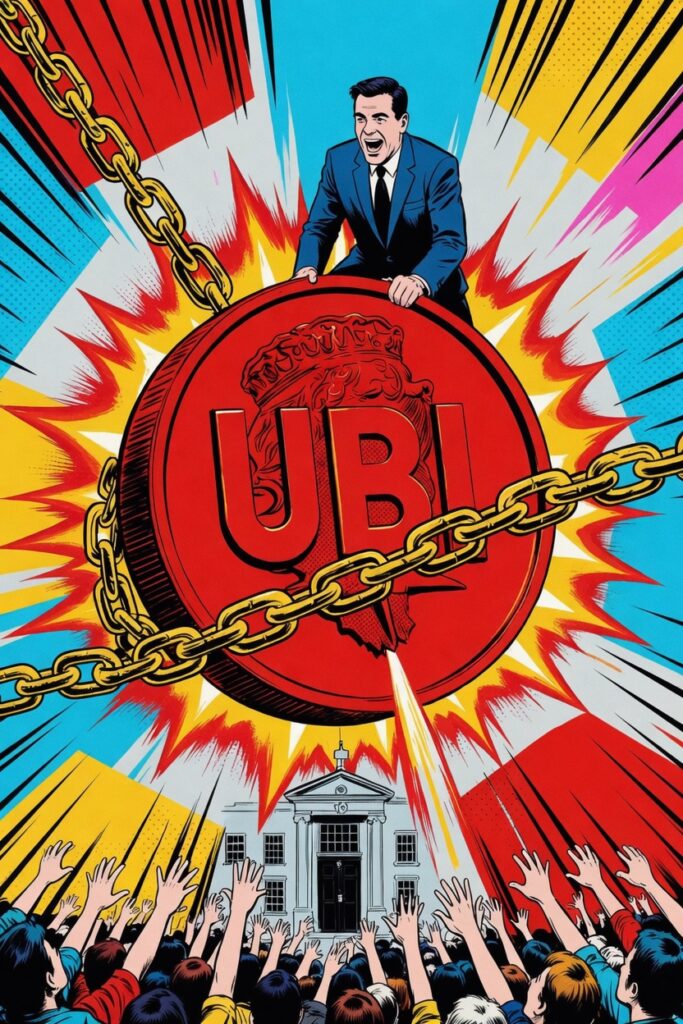
This is Part Three of a series on Universal Basic Income.
Part One examined what UBI is and whether it works.
Part Two asked who pays for it.
This part asks whether UBI could actually work in the UK… and what happens when a true believer might be heading for Downing Street.
Andy Burnham called Universal Basic Income (“UBI”) “an idea whose time has come.”
He pledged a basic income pilot in his 2024 Greater Manchester mayoral re-election manifesto and has backed the UBI Lab Network’s proposal to test unconditional cash transfers for homeless people in his city-region.
Now, following this week’s decision by Labour’s NEC to allow him to contest the Makerfield by-election on 18 June, Burnham has a clear path back to Parliament… and, potentially, to challenge Keir Starmer for the Labour leadership.
If he wins both contests, Britain could have a Prime Minister who has spent years championing basic income as “a different, more preventative way” of tackling poverty.
That makes the question this article asks rather more urgent than it was a month ago. Could UBI actually work in the UK?
UBI has entered British political conversation with increasing frequency. Not as policy. Not yet. But as an idea that refuses to stay on the fringe.
The Green Party has adopted UBI as official policy.
The SNP has backed pilot schemes.
Wales ran the UK’s first significant basic income pilot from 2022 to 2024.
YouGov found in October 2024 that 46% of Britons support UBI, against 27% who opposed it.
The AI displacement argument has given UBI new momentum. Science Minister Matt Stockwood has publicly floated the idea of a “windfall levy on tech companies” to fund support for workers displaced by automation.
So, the question is no longer whether the UK is talking about UBI. It is whether any version of it could actually work here.
Before we get to national implications, it’s worth understanding what Burnham has actually proposed and what hasn’t materialised.
In February 2025, Northumbria University and the UBI Lab Network sent Burnham a detailed proposal for a basic income pilot targeting homeless people in Greater Manchester.
The logic was “preventative” spending. In other words, give people a stable income floor and see whether they avoid costly crisis interventions such as emergency housing, A&E visits, the criminal justice system.
“We completely agree with Mayor Burnham that preventative spending is the future,” the research team said. Burnham’s office responded warmly, calling it “exactly the kind of thinking we need.”
That was fifteen months ago.
The pilot, as far as I can see, has not launched. As of March 2026, advocacy groups were still describing it as a “proposal.”
Wales remains the only jurisdiction in the UK to have actually run a basic income trial.
This is itself instructive.
Even a small, targeted pilot for a few hundred homeless people, funded by external private money, backed by the mayor, with academic support… has not got off the ground.
The gap between rhetorical support and operational reality is wide even at this scale.
The gap between piloting basic income for a few hundred homeless people and implementing it for 52 million UK adults is manifold.
And that gap is measured in hundreds of billions of pounds.
Part Two laid out the funding question in detail.
In summary, estimates for a full UK UBI range from £67bn to £678bn annually, depending on generosity.
The IFS calculated that paying every working-age adult just £400 per month, roughly Universal Credit equivalent, would cost over £200 billion per year. More than the entire NHS budget.
A meaningful UBI requires either tax rises that would fundamentally restructure the relationship between work and reward, or a wholesale replacement of existing benefits that might leave many current recipients worse off.
There is no version that is both generous and financially painless.
If Burnham reaches Downing Street on a wave of enthusiasm for basic income, he will need to make the maths, math.
This is where the UBI debate tends to stop being honest, and where a Prime Minister Burnham would face his hardest questions.
Proponents focus on the purported benefits for recipients such as the security, the dignity, the improved mental health.
The evidence on those points is reasonable, [as Part One showed](https://breakingtax.com/the-futures-been-sold-what-is-ubi-and-does-it-actually-work/).
Pilots from Finland to Wales to Kenya suggest that unconditional cash helps people, at least in the short term, at least when someone else is footing the bill.
But a UBI funded by dramatically higher marginal tax rates does not only affect recipients.
It affects everyone who would be paying for it.
The UK already has a problem retaining high earners.
The non-dom reforms have made the UK less attractive to internationally mobile wealth.
The additional rate of 45% (plus NICs, plus various allowance tapers) already creates effective marginal rates above 60% for many.
The tax rises required for a meaningful UBI (Part Two) walked through Autonomy’s modelling, which showed marginal rates pushing into the high 70s, would sharpen this problem considerably.
At those levels, every additional £100,000 of UK income yields barely £20,000 after tax.
For someone with global mobility, the question becomes why would you stay?
The UK is not an island (metaphorically speaking, literally it is!). It competes for talent, capital, and headquarters with jurisdictions that offer better personal tax treatment.
Portugal, the UAE, Switzerland, Singapore all remain options for those with flexibility (though migration is more than just the % tax figure you pay)
High marginal tax rates do not only affect the employed. They affect founders too.
An entrepreneur deciding whether to build a company in the UK weighs up many factors including access to talent, capital markets, rule of law.
But they also weigh up what happens when they succeed.
If success means handing over 78% of marginal gains, some will still build here.
Others will not.
Some will incorporate elsewhere.
Some will emigrate before exit.
Some will simply not start.
The UK has spent years cultivating an entrepreneurial ecosystem including things such as EIS, SEIS, R&D credits, Business Asset Disposal Relief (and its ancestors).
The logic behind all of these is that risk-taking should be rewarded, because it generates growth, jobs, and tax revenue over time.
A UBI funded by rates in the 70s pulls in precisely the opposite direction.
Economic models assume static behaviour. Real humans respond to carrots and sticks.
Every costing of UBI assumes the tax base sits still while rates rise.
But the question is always where is the tipping point? And nobody knows until it tips.
Ireland did not become a European tech hub by accident. Luxembourg did not attract holding companies through charm.
A UK Prime Minister committed to funding UBI through aggressive taxation would be betting that the UK’s tax base is stickier than history, and common sense, suggests.
If Andy Burnham becomes Prime Minister on a platform sympathetic to basic income, he will confront three questions that pilot programmes never have to answer:
#1 Universality v targeting
A universal payment sends money to people who do not need it. For the same budget, targeted support can be more generous to those in genuine need.
UBI advocates argue that universality reduces stigma, simplifies administration, and avoids the cliffs and traps of means-testing.
These are benefits. But they come at a cost. Either spreading resources thinly, or raising much more revenue to spread them thickly.
Burnham’s Greater Manchester proposal was deliberately targeted – homeless people, not everyone.
Would he maintain that pragmatism nationally, or reach for true universality?
#2 Funding Without Destruction
A UBI funded by modest reforms might be achievable but weak. In other words, too little to provide real security.
A UBI funded by the tax rises the models require might be generous but economically destructive and triggering the behavioural responses that erode the tax base funding it.
There may be no stable equilibrium between the two.
#3 The AI architecture gap
Part Two argued that the AI-UBI story only works if AI-driven productivity gains appear in taxable form in the UK.
If AI increases profits booked offshore, or consumer surplus through lower prices, the Treasury gains nothing.
If AI displaces workers faster than the economy creates new roles, the income tax base shrinks at exactly the moment UBI becomes more urgent.
The AI case for UBI is compelling in theory. In practice, it requires a tax state capable of capturing AI-era rents and the UK has not yet built one.
A Prime Minister committed to UBI would need to build that architecture first. That is years of work before the first universal cheque could be written.
Andy Burnham has done something unusual for a British politician by taking UBI seriously, consistently, for years.
His Greater Manchester pilot, if it ever proceeds, will add to the evidence base. His political rise means that evidence may soon matter at the highest level.
But there is a vast distance between supporting pilots and implementing national policy.
Burnham has not even managed to launch the small, targeted pilot he endorsed fifteen months ago. The leap to national implementation is orders of magnitude harder.
The pilots tell us that unconditional cash can help people. What they cannot tell us is whether a universal payment, funded by dramatically higher taxes on the mobile and the motivated, would leave the UK better off overall.
Andy Burnham may believe UBI’s time has come. If he reaches Downing Street, he will discover that believing it and funding it are two very different things.
The future may have been sold…
…But the price is still being negotiated.


Published 1 October 2026
Read More

Published 23 September 2026
Read More
Published 17 September 2026
Read More
Published 5 September 2026
Read More
Published 30 August 2026
Read More