
CONFERENCE SEASON: THE TORIES TAKE AIM AT THE GRIEF TAX
Read more

April 30, 2026 | 17 min read
Author: Andy Wood
This is the next century
Where the universal’s free
You can find it anywhere
Yes, the future’s been sold
— Blur, ‘The Universal’
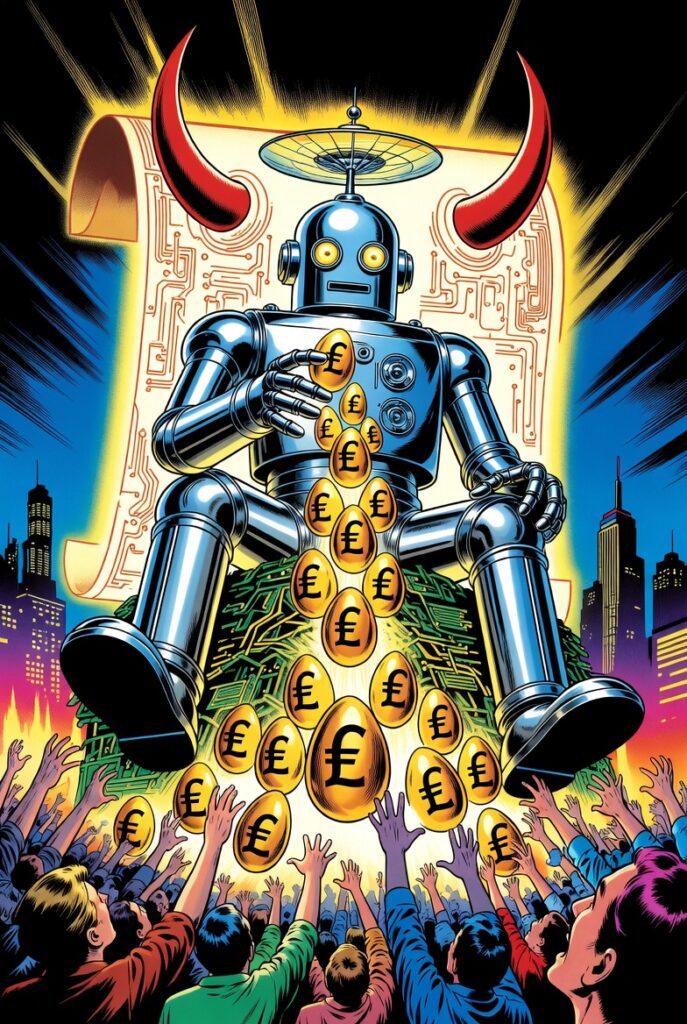
The human race has entered into a Faustian pact with AI. We have sold our working futures to the robots.
At least, that’s the hopeful version of the story. We let machines do more of the work. They produce more, faster and cheaper. The productivity gains are so large that society can afford to pay everyone a basic income. The robots get the work. We get the dividend.
Yeah?
Yeah??
Well, perhaps. But before we start dividing up the proceeds of the machine age, we need to ask what UBI actually is, what the evidence says, and, most awkwardly, who pays.
UBI is not only a welfare question. In an AI economy, it quickly becomes a tax-base question.
This is Part One, covering what UBI is and whether it works. [Part Two]tackles the harder question: who pays for this?
UBI is best understood as a family of designs, not a single policy.
At its core, universal basic income means a regular cash payment, paid on an individual basis, with no or minimal conditions, to everyone or almost everyone. That sounds simple enough. But the simplicity is partly illusory.
The IMF has warned that the term is used loosely in public debate. The International Labour Organization makes a similar point, treating UBI proposals as a spectrum that can be compatible or incompatible with wider social-protection goals depending on how they are designed.
That distinction matters, because four related but different ideas are often collapsed into one:
Treating these as interchangeable makes the evidence look much cleaner than it really is.
Finland was not a national UBI.
Stockton was not a universal scheme.
OpenResearch was not a state-funded permanent basic income.
They are still useful evidence, but they are evidence about particular cash-transfer designs, not proof that every version of UBI works.
The arguments for and against UBI change sharply depending on design.
Is the payment made to individuals or households? Adults only, or children too? Citizens only, or long-term residents? Is it taxable? Is it indexed? Does it supplement existing benefits or replace them? Is it monthly, annual, or a hybrid of regular payments and occasional larger grants?
The ILO stresses adequacy, predictability, indexation, inclusion and coherence with employment and social policy. The IMF frames the core trade-offs as coverage versus leakage, generosity versus incentives, and fiscal cost versus alternative uses of revenue.
Even delivery is less straightforward than “the government sends everyone money”.
In Stockton, prepaid debit cards were used rather than bank transfers because many residents were unbanked. In Iran’s near-universal subsidy-compensation scheme, linked national databases allowed household information to update automatically.
In practice, the international question is not just whether a state can pay people. It is whether it can do so inclusively, reliably and without creating new forms of exclusion.
Thomas Paine is often invoked in the history of UBI, but he is better seen as a precursor than as the author of a modern UBI blueprint.
In Agrarian Justice, Paine argued that private ownership of land excluded people from a common inheritance. His proposal was therefore not “free money” in the modern sense. It was compensation. Natural resources belonged, morally, to everyone. If private property created exclusion, then part of the proceeds should flow back to citizens.
That makes Paine’s idea closer to a land-value tax or citizen-dividend model than to a modern monthly welfare payment.
Milton Friedman belongs in the story too, but for a different reason. His negative income tax was not primarily about universal citizenship income. It was about simplification, administrative efficiency and avoiding some of the distortions of welfare bureaucracy.
Martin Luther King Jr adds a third lineage. His case for guaranteed income was rooted in exclusion, involuntary unemployment and dignity. In 1967, he argued that society must either create full employment or create incomes, and he linked economic security to personal dignity and self-improvement.
Later thinkers such as Philippe Van Parijs and Anthony Atkinson gave the modern debate more of its philosophical and policy architecture.
The common thread is not “free money”. It is the claim that a decent society should provide some kind of economic floor that is not wholly dependent on labour-market success.
UBI-type proposals tend to re-emerge when labour markets are being reorganised, when poverty persists despite growth, or when existing welfare systems look badly matched to economic reality.
That is why the idea has returned now. The current revival reflects three pressures arriving together: precarious work, frustration with means-tested welfare, and renewed anxiety about automation and AI.
In richer economies, the appeal is often about insecurity. The labour market is more fragmented. Self-employment, platform work and non-standard contracts do not always fit neatly into old welfare systems. Finland’s basic income experiment, for example, was motivated in part by concern that the existing social-security system no longer fitted atypical work arrangements.
In lower-capacity states, the appeal can be different. Universality may reduce exclusion errors and administrative burdens because the state does not need to identify the poor with precision. But poorer countries also face tighter revenue constraints, so a generous universal transfer can crowd out spending on health, education or infrastructure.
So UBI is not a universal best practice. It is a trade-off between simplicity, coverage, fiscal capacity and opportunity cost.
The best pro-UBI argument is not that people should stop working.
It is that unconditional income changes the baseline from which people make decisions.
Means-tested systems often withdraw benefits abruptly as income rises. That can create cliffs and traps. People may fear taking work, increasing hours or starting a small business if the immediate effect is to lose support. A universal payment avoids those sharp withdrawal points because it is not removed when someone earns more.
Finland’s experiment was built around this logic. Give people a stable floor and see whether they become more willing to accept work without fear of losing support.
On wellbeing, the evidence is stronger than the evidence on employment. Finland found small employment effects but better mental wellbeing and stronger perceived economic security. Stockton found lower income volatility, better mental health and more room for self-determination. OpenResearch found more budgeting and planning, more reported education or training activity, and more willingness to search for better-fitting work. In Kenya, long-horizon cash support increased savings, investment and shifts towards self-employment rather than simple withdrawal from work.
The defensible claim is therefore modest but important: unconditional cash tends to increase agency.
It gives people more room to stabilise, plan, retrain, refuse bad jobs, care for family or make lumpy investments. That matters. But it is weaker and more nuanced than saying UBI automatically creates entrepreneurship or permanently solves poverty.
The fiscal objection remains the central one.
OECD simulations across European countries found that a budget-neutral basic income replacing most working-age benefits and tax allowances would generally be well below the poverty line and could leave some current low-income recipients worse off.
That is the basic dilemma. A small UBI is affordable but weak. A meaningful UBI is stronger but very expensive.
The targeting critique is also serious. For a fixed budget, targeted transfers can deliver more money to poorer households because the money is concentrated rather than spread across the entire population. Universality buys simplicity and inclusion, but it also sends money to people who do not need it unless the tax system claws it back effectively.
There is also a public-services critique that deserves more weight than it usually gets in Silicon Valley versions of the debate. If a UBI is financed by hollowing out other parts of the social state, then the relevant comparison is not “UBI versus nothing”. It is UBI versus better housing support, childcare, health, disability support or employment services.
Flat cash looks elegant partly because it ignores the fact that human needs are unequal.
The simple claim that unconditional cash causes mass withdrawal from work is not well supported.
Alaska’s Permanent Fund Dividend had no detectable effect on aggregate employment and appears to have increased part-time work. Finland found small employment effects overall. OpenResearch found a modest fall in employment and hours – recipients worked 1.3 fewer hours per week and were 2 percentage points less likely to be employed – but also found more active job search and more selectivity about what kinds of jobs people would accept.
The more accurate summary is that unconditional cash changes how people participate in work rather than simply switching work off.
Some people work a little less. Some search longer. Some move into self-employment. Some reallocate time towards family, education or training. Some use the floor to avoid the worst jobs.
That is not a trivial effect. If a UBI makes it easier to say no to bad work, employers may need to improve pay and conditions. Supporters see this as a feature. Critics see it as a cost. Both are partly right.
Alaska is the closest enduring real-world example — though it is not a full UBI. It is a universal cash dividend: annual, variable and far too small to replace earnings or a welfare state. It shows that unconditional universal payments can coexist with stable labour-market participation, not that a full UBI is fiscally easy.
Finland was an unemployment-focused test of unconditionality. Its key contribution is proof that a simpler, more unconditional floor can improve wellbeing without causing dramatic labour-market collapse. It does not prove that a permanent national UBI would work.
Kenya (GiveDirectly) is the closest thing to a long-horizon experimental UBI, where every adult in treated villages received regular payments for either 2 or 12 years. Its most interesting finding is that duration and cadence matter. A 12-year commitment and a lump sum both outperformed a short two-year monthly design on a number of outcomes, which suggests that “cash” is not one treatment and timing can be as important as amount.
Stockton and OpenResearch (US) provide evidence on guaranteed income rather than universal basic income. Still useful for showing what unconditional cash can do for financial stability, mental wellbeing, planning and job choice. But they should not be presented as direct evidence for a universal national UBI.
Iran is important because it is one of the rare examples of a nation-scale, near-universal cash transfer. It shows that broad cash distribution is administratively possible. It also shows the fragility of value under inflation and the political tendency for universal schemes to drift back towards selectivity over time.
The honest evidential position is this: unconditional cash has a decent record. Full permanent UBI has not really been tested in the way its strongest advocates sometimes imply.
The answer depends entirely on what you mean by “work” and what you mean by “UBI”.
If the question is whether unconditional cash can improve wellbeing, reduce volatility and increase agency without causing mass withdrawal from work… then, yes, there is reasonable evidence for that.
If the question is whether a full, permanent, universal basic income can replace large parts of the welfare state while remaining fiscally sustainable and politically durable… well, that remains unproven.
But there is a harder question lurking behind the policy debate. Even if UBI *could* work, who pays for it? And in an AI economy, that question has a sting in the tail.
That’s Part Two.
—
This is Part One of a two-part series. Part Two: Who Pays for UBI? Examines the tax problem at the heart of the AI-UBI promise.*
Finland’s experiment was the most methodologically rigorous national-level UBI trial to date. The government randomly selected 2,000 unemployed people from across the country and paid them €560 per month for two years—unconditionally, tax-free, and without means-testing.
Crucially, participation was compulsory for those selected, eliminating the self-selection bias that undermines many social experiments.
The employment effects were modest but positive: recipients worked an average of 6 more days during the measurement period than the control group.
The more striking findings were on wellbeing. Recipients reported significantly better mental health, less depression and loneliness, greater life satisfaction, and improved cognitive function (memory, concentration, learning). They also felt more financially secure and in control of their lives.
The Finnish government concluded that while this specific model would not be adopted wholesale, the data would inform future social security reform. Finland was an unemployment-focused test of unconditionality.
Its key contribution is proof that a simpler, more unconditional floor can improve wellbeing without causing dramatic labour-market collapse.
It does not prove that a permanent national UBI would work, but it does suggest the “people will stop working” fear is overblown.
GiveDirectly’s Kenya pilot is the largest and longest-running UBI experiment in the world.
Beginning in 2016 and running until 2028, it provides approximately $22.50 per month to around 6,000 people in rural villages, enough to meaningfully supplement but not replace local incomes. The study, led by MIT economists including Nobel laureate Abhijit Banerjee, compares three groups:
Early results (covering 2018–2020) found that lump-sum recipients outperformed monthly recipients on most financial metrics, they started more businesses, earned more, and invested more in education.
The likely explanation: a $500 lump sum provides startup capital, whereas $20/month requires disciplined saving to accumulate the same.
However, long-term monthly recipients found a workaround: they used rotating savings and credit associations (ROSCAs) to convert their streams into periodic lump sums for investment.
On mental health, monthly recipients, especially long-term ones, reported significantly better wellbeing, likely due to the security of knowing the income would continue.
Notably, none of the payment structures reduced work effort or increased alcohol spending. Kenya’s most interesting finding is that duration and cadence matter: “cash” is not one treatment, and timing can be as important as amount.
The Stockton Economic Empowerment Demonstration (SEED) was a privately-funded pilot launched by then-Mayor Michael Tubbs in February 2019.
It gave 125 randomly selected residents, all living in neighbourhoods at or below Stockton’s median household income, an unconditional $500 per month for two years.
The design was straightforward: no strings, no conditions, just cash on a debit card.
The results, studied by independent researchers from the University of Pennsylvania and University of Tennessee, were notably positive. Full-time employment among recipients rose by 12 percentage points compared to the control group, directly contradicting the criticism that free money discourages work.
Recipients reported reduced anxiety and depression, greater financial stability, and less month-to-month income volatility.
Spending data showed the money went overwhelmingly to necessities (food, utilities, transport), with less than 1% spent on alcohol or tobacco.
The pilot also revealed ripple effects: stabilising one household reduced strain on extended family and community networks that had previously filled the gaps.
Stockton is evidence about guaranteed income rather than universal basic income, but it remains useful for showing what unconditional cash can do for financial stability, mental wellbeing, and job choice.
Sam Altman’s OpenResearch study provided $1,000 per month to 1,000 low-income Americans across Texas and Illinois for three years, with a control group receiving $50 per month.
It is the largest randomised controlled trial of unconditional cash in the United States.
The findings were mixed but instructive. Recipients worked modestly less, about 1.3 fewer hours per week, and were 2 percentage points less likely to be employed.
But they also reported more active job searching, more education and training activity, and more willingness to hold out for better-fitting work rather than taking the first thing available.
The study found improved mental health, better budgeting and planning, and more financial stability.
Critics seized on the employment reduction; supporters argued it showed people using the floor to make better long-term decisions rather than simply opting out.
Like Stockton, OpenResearch is evidence about guaranteed income for a targeted group, not a universal national scheme, but it adds to the picture of what unconditional cash enables.
Alaska’s Permanent Fund Dividend (PFD) is the closest thing to a long-running, universal cash transfer in a developed economy.
Since 1982, every eligible Alaskan resident has received an annual dividend drawn from the state’s oil wealth, typically ranging from $1,000 to $2,000, though amounts vary with investment returns.
It is universal (not means-tested), unconditional, and has been paid continuously for over 40 years.
A 2018 study published in the American Economic Journal found that the dividend had no negative effect on employment.
In fact, part-time work increased by about 1.8 percentage points (17%), suggesting people used the flexibility to balance work with other priorities rather than dropping out of the labour force entirely. Alaska shows that unconditional universal payments can coexist with stable labour-market participation.
But the PFD is far too small to replace earnings or a welfare state, it functions more as a modest annual bonus than a liveable income floor.
It proves the concept is not inherently destructive; it does not prove that a full UBI is fiscally easy.
Ontario launched a three-year basic income pilot in 2017, providing up to CAD $16,989 per year for singles and $24,027 for couples (minus 50% of any earned income) to 4,000 participants in Hamilton, Thunder Bay, and Lindsay.
It was designed to test whether a guaranteed income floor could improve health, housing stability, education, and employment outcomes for low-income Ontarians.
The experiment was abruptly cancelled in 2018, after just one year, when the newly elected Progressive Conservative government terminated it, citing cost and a belief that it was “not helping people become independent contributors to the economy.”
No official results were ever published because the study never completed.
Researchers and participants were dismayed; some speculated the cancellation was politically motivated precisely because early indications suggested it was working.
Ontario remains a cautionary tale, not about UBI’s effectiveness, but about the vulnerability of long-term social experiments to political cycles.
Iran is important because it is one of the rare examples of a nation-scale, near-universal cash transfer.
When the government removed fuel and food subsidies in 2010, it compensated citizens with direct cash payments, initially around $45 per person per month, paid to household heads covering all family members.
At its peak, the scheme reached over 70 million people.
Early studies found no significant negative effects on labour supply. The transfers were administratively feasible even in a middle-income country with imperfect infrastructure.
But Iran also illustrates the fragility of such schemes: inflation eroded the real value of payments, and political pressures led to gradual moves back towards targeting and selectivity.
Iran shows that broad cash distribution is possible at scale.
It also shows that “possible” and “sustainable” are not the same thing.
Published 1 October 2026
Read More

Published 23 September 2026
Read More
Published 17 September 2026
Read More
Published 5 September 2026
Read More
Published 30 August 2026
Read More

Published 18 June 2026
Read More