
CONFERENCE SEASON: THE TORIES TAKE AIM AT THE GRIEF TAX
Read more

May 7, 2026 | 9 min read
Author: Andy Wood
This is Part Two. Part One covered what UBI is and whether it works. This part tackles the harder question.
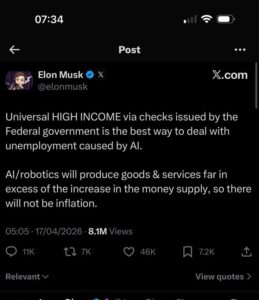
The optimistic version of the AI-UBI story goes something like this:
AI replaces labour.
Companies become vastly more productive.
Profits soar.
The state taxes those profits.
Everyone gets a UBI.
Job done.
Lovely.
But that assumes the abundance created by AI arrives in a form the state can easily tax. And that is a very large assumption.
The AI case for UBI is straightforward in theory.
If automation displaces workers faster than economies generate new roles, then income needs to be decoupled, at least partly, from employment. The more work is done by machines, the more pressure there is to share income through some mechanism other than wages.
The IMF has estimated that AI may affect almost 40% of jobs globally and about 60% in advanced economies, with some jobs complemented and others threatened. The point is not that every exposed job disappears. It is that the labour market could be transformed unevenly and at speed.
That makes the Musk-style “abundance cancels inflation” argument coherent only as a conditional claim.
It works if AI productivity gains are broad rather than narrow, if they diffuse into lower costs or higher taxable incomes rather than being captured as rents, and if politics redistributes at least some of the gains.
The evidence today supports the idea that AI can raise productivity in some sectors. It does not yet prove mass permanent joblessness.
Nor does it prove that any resulting abundance will be broadly shared. History does not give us much reason to assume that abundance distributes itself.
That brings us to the uncomfortable question.
This is where the UBI debate usually gets a little hand-wavy.
The UK tax system depends deeply on human participation. Income tax and National Insurance are the heavy-lifters. If businesses replace large swathes of their workforce with machines, those revenues can be hollowed out. Corporation tax might plug the gap in a static model, but only if labour-cost savings turn neatly into taxable profits.
Real life is annoyingly non-static.
If AI makes services cheaper, faster and easier to deliver, competition may force businesses to pass some or all of those gains to customers through lower prices. That is good for consumers. But it is not necessarily a corporation tax bonanza.
The scale of the labour-tax base is not small. The OBR estimates that income tax will raise around £329 billion in 2025-26, representing 26.7% of all receipts. National Insurance Contributions add another £205 billion, or 16.7% of receipts. Together, that is over 43% of all tax revenue. A tax base of that scale does not get replaced by vibes.
A post-scarcity economy does not automatically produce a post-scarcity Treasury.
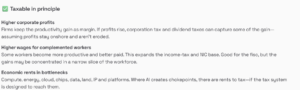
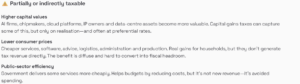
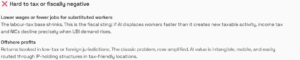
That is the central problem. AI may increase real welfare while weakening some of the tax bases on which welfare states currently rely.
A tempting answer is to say that corporation tax will take over. If a business replaces 1,000 workers with AI systems, surely labour costs collapse, profits rise and the Exchequer simply taxes the extra profit?
Perhaps.
But only if the gain appears as taxable profit in the right jurisdiction at the right time.
In competitive markets, profits may be competed away. In international markets, profits may be shifted. In AI-heavy markets, value may sit in intellectual property, data, compute, cloud infrastructure or network effects that are difficult to allocate neatly to one country.
International coordination helps. The OECD global minimum tax is designed to ensure large multinational groups face at least a 15% effective tax rate in each jurisdiction where they operate. But that is an attempt to defend the corporate tax base, not a complete answer to how one funds a UBI.
Corporation tax may be part of the answer.
It is unlikely to be the answer.
A robot tax has intuitive appeal because it appears to replace lost payroll tax with a tax on the thing doing the replacing. If a company swaps workers for AI agents, why not levy a charge equivalent to the missing employer NICs?
The problem is definition.
What counts as a robot?
A humanoid machine?
A warehouse arm?
A self-checkout?
A chatbot?
A piece of accounting software?
A spreadsheet macro?
An AI co-pilot?
A model embedded inside HR, law, finance, medicine or logistics?
Draw the line too narrowly and the tax raises little. Draw it too broadly and you are taxing ordinary business software. Tax it too heavily and you slow investment. Tax it too lightly and it does not replace the labour-tax base. Tax it nationally and activity may move.
The IMF has argued against a blunt AI-specific tax, warning that it could slow useful investment and be hard to implement. But it also points towards stronger capital income taxation, stronger corporate income taxes, possible excess profits taxes, stronger capital gains taxation and better enforcement.
That seems right. The better target is not robots as objects. It is AI-related rents, capital income, monopoly power and tax rules that currently favour machines over people.
Tax the rents, not the robots.
A compute tax is the more modern version of the robot tax.
Rather than taxing “robots”, one taxes the inputs used to build and run AI: data centres, chips, electricity, server capacity, model training, inference or cloud compute.
This is rhetorically elegant but policy-thin.
Compute is an input, not a clean tax base in the way wages are. Tax it bluntly and you hit electricity use, capex and location choices. Tax it lightly and it does not raise anything like what labour taxes raise.
That does not mean compute should be ignored. There may be a case for charges linked to energy use, water use, grid pressure, carbon emissions, land value uplift, local infrastructure burdens or planning gains. But that is not the same as saying compute can replace income tax.
A compute tax might help fund an AI transition package. It is much harder to see it funding a full UBI.
This is the distinction that matters.
A full UBI is a redesign of the welfare state. It needs a broad and durable funding base. That almost certainly means some combination of income tax, National Insurance or payroll taxes, VAT, corporation tax, capital taxation, wealth transfer taxes, existing welfare spending and tax relief reform.
An AI dividend is different.
An AI dividend would be a claim on specific AI-era rents. It could be funded from excess profits, public stakes, data licences, compute-related rents, land value capture, carbon or energy levies, sovereign wealth fund returns, or taxes on monopoly gains.
That is closer to the Alaska-style social dividend idea than to a full UBI. It says citizens should share in the returns from common or publicly enabled assets.
And there is a good philosophical argument for that. AI is not being built in a vacuum. It rests on public education, public research, public infrastructure, public legal systems, publicly protected intellectual property and the collective data exhaust of society.
So the claim is not merely: give people free money. It is: if private AI systems are built partly on a common inheritance, the public should retain some claim on the proceeds.
In the end, there are only a few possible answers.
There is no magic payer hiding inside the machine.
The honest answer is that a meaningful UBI cannot be funded simply by saying “AI will pay for it”. AI does not pay tax. Robots do not pay tax. Models do not pay tax. Data centres do not feel incidence.
People pay tax.
The political question is which people.
If AI mainly increases wages and productivity across the economy, the existing tax system may adapt. If AI mainly increases profits, asset values and rents, capital taxation becomes more important. If AI mainly lowers prices, consumers may enjoy abundance but the Treasury may still have a problem. If AI mainly hollows out employment while concentrating gains in a few mobile firms, then the tax state has a very serious problem indeed.
That is why UBI cannot be separated from tax reform.
The future may have been sold. But someone still has to collect the invoice.
The most defensible conclusion is not that UBI has been vindicated or disproved. It is that the international evidence is stronger on the benefits of unconditional cash than on the case for a full permanent UBI.
Cash can stabilise lives, improve mental wellbeing, reduce scarcity-driven decision-making and modestly improve people’s bargaining position in the labour market.
But the evidence is much thinner on whether a large, permanent, tax-financed UBI in an advanced economy could replace major parts of the welfare state without creating fiscal or political strain.
The most plausible path is probably a hybrid: some combination of guaranteed minimum income or negative-income-tax logic, retained needs-based benefits, and social dividends where there are identifiable common-asset rents.
The reason UBI remains powerful is not that the economics are settled. It is that the idea forces a harder political question: should basic economic security attach to a person’s status as a citizen or resident, or only to their success in the labour market?
UBI sounds like one policy, but it is really a fight between three different visions:
The problem is that most public debate blurs them together.
Universal. Blur. See what I did there?
—
This is Part Two of a two-part series. Part One covers what UBI is and whether it works.
—
Sources
1. IMF, “What Is Universal Basic Income?”
2. ILO, “Universal Basic Income proposals in light of ILO standards”
3. OECD, “Basic income as a policy option”
4. Kela, “Basic income experiment” (Finland)
5. GiveDirectly, Kenya UBI study
6. Stockton Economic Empowerment Demonstration
7. OpenResearch, Unconditional Cash Study
8. UNICEF, “The Experience of Iran”
9. IMF, “AI Will Transform the Global Economy”
10. IMF, “Fiscal Policy Can Help Broaden the Gains of AI to Humanity”
11. OBR, Income Tax and NICs forecasts
12. OECD, Global Minimum Tax

Published 1 October 2026
Read More

Published 23 September 2026
Read More
Published 17 September 2026
Read More
Published 5 September 2026
Read More
Published 30 August 2026
Read More

Published 18 June 2026
Read More