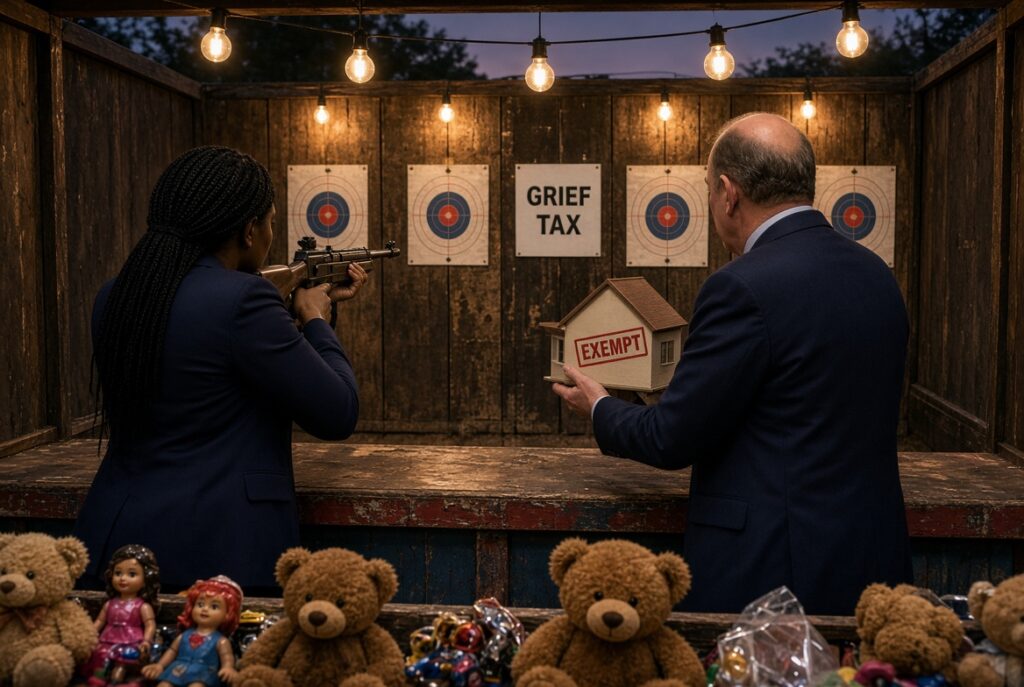
CONFERENCE SEASON: THE TORIES TAKE AIM AT THE GRIEF TAX
Read more

May 10, 2026 | 9 min read
Author: Andy Wood
UK Tax Policy Mid-Terms: #1 Labour
Part 1 of 6 | The Government’s Report Card
Two years ago, I reviewed Labour’s tax manifesto and concluded it was exactly what you’d expect from a party that was firmly in “not buggering it up” mode.
No surprises. No hostages to fortune. A carefully calibrated exercise in saying as little as possible while promising change.
Well, they won. And now we get to see how that manifesto held up against the realities of actually running the Treasury
Let’s be fair. Labour has delivered on quite a lot of the promises it made.
Whether they have quite ‘hit the spot’ from a revenue perspective is a wholly different matter.
VAT on private schools?
Done.
Implemented from January 2025, despite gnashing of teeth from the Independent Schools Council claiming it had been “blindsided”… as if this hadn’t been Labour policy since approximately the Jurassic period.
And how’s it working out?
Well, we are told that over 100 private schools have closed. More than 25,000 children have been displaced into the state system.
The government’s own estimates show state school costs for absorbing these pupils at hundreds of millions per annum [1] against projected revenue of £460 million in year one.
Fees rose 22%, not the 10% Treasury predicted. The schools that closed weren’t Eton and Harrow. They’ll absorb it as a rounding error. However, the schools that did close were small faith schools, regional independents, the ‘affordable end’ of the market.
The policy has become a masterclass in achieving the opposite of its stated aims. It has achieved minimal net revenue, maximum disruption, a (failed) legal challenge the High Court, and the strange spectacle of a Labour government making private education more exclusive.
As fiscal policy, it’s borderline pointless.
As ideological totem pole, it is, apparently, worth every penny.
Done.
The remittance basis went the way of the dodo (as it happens, the dodo died out just about a century before the remittance basis was first introduced) from April 2025.
It has been replaced with the snappily-titled Foreign Income and Gains (FIG) regime, which sounds like an Instagram detox programme but is actually a four-year tax holiday for the UK’s newcomers on foreign income and gains.
The Tories had already announced this was coming, with Labour adopting those planned changes wholesale and adding the disastrous cherry on top of the fetid cake by refusing to grandfather existing trusts for IHT.
Even more teeth were gnashed.
So, how’s it working out?
The Treasury insists the policy will raise £33.8 billion over five years.
Perhaps.
But that forecast assumed the wealthy would largely grumble and stay… rather than grumbling and booking one-way tickets to Dubai, Milan, and Monaco.
The OBR’s modelling assumed 12-25% of non-doms would leave, yet Oxford Economics, surveying actual non-doms and their advisers, found 63% intended to depart within two years.
Even on Oxford’s more conservative estimate of 32% departures, the policy tips into revenue-negative territory.
The Centre for Economics and Business Research is blunter, stating that, at a 25% departure rate, the net gain to the Treasury would be zero. Run the numbers at 50%, then it’s a £2.4 billion annual loss.
Non-doms paid £8.9 billion in UK taxes in 2022-23. You don’t need a calculator to see the arithmetic turning hostile.
There is more evidence. Henley & Partners reports (albeit those reports have been criticised) the UK lost 10,800 millionaires to emigration in 2024, up 157% on the previous year, and predicts 16,500 will leave in 2025. The highest outflow of any country they’ve tracked in a decade.
Prime London property transactions have reportedly collapsed 36% year-on-year by May 2025.
The gilded names are already gone. Goldman Sachs’ vice-chairman has gone to Italy, Egypt’s richest man has gone to the Emirates, Norway’s shipping titan has gone to Dubai.
The 2026 Sunday Times Rich List, published this week, puts more numbers to the exodus.
Robert Watts, who compiles the list, describes “a tale of two exoduses”. One in six individuals and families from two years ago have vanished from the rankings entirely.
Many foreign billionaires have simply left.
Meanwhile, there’s been “a sharp rise” in British nationals now resident in Dubai, Switzerland, and Monaco. They remain on the Rich List as UK nationals, but whether they remain as meaningful UK taxpayers is another question entirely.
The Rich List is becoming less a measure of “wealth in Britain” and more a measure of “wealth that once touched Britain.”
Of course, for balance, the Treasury may yet be proved right. HMRC’s preliminary data suggests departures remain within forecast bounds.
But betting £33.8 billion on the tax residency loyalty of the globally mobile rich looks increasingly like wishful arithmetic.
Corporation tax capped at 25%? Kept.
Energy Profits Levy extended? Yep.
SDLT surcharge on non-residents increased? From 2% to 3%.
Foreigners with the temerity (the rotters!) to buy UK property now face a potential 18% SDLT rate.
I always say that a popular tax is one paid by someone else… an even more popular tax is one paid by a someone else who is also a non-voting foreigner!
So far, so manifesto.
Here’s where it gets interesting.
Labour’s central tax promise was crystalline in that “we will not increase taxes on working people.” Specifically, no increases to income tax, National Insurance, or VAT rates.
They kept the letter of this promise. The rates have remained unchanged.
But the spirit?
That’s been doing some heavy lifting.
The threshold freeze extension. Labour promised not to extend the frozen income tax thresholds beyond the Tories’ existing plans. At the 2025 Budget, Rachel Reeves extended them to 2031. The OBR estimates fiscal drag from frozen thresholds will pull 780,000 more people into paying tax for the first time.
Is freezing a threshold technically a “rate increase”? No. Does it feel like one when inflation has eaten your pay rise and you’re suddenly a higher-rate taxpayer? Absolutely.
The employers’ National Insurance hike. This was the big one. From April 2025, the rate went up from 13.8% to 15%, threshold down from £9,100 to £5,000. The OBR called it the biggest revenue-raiser since 1993.
Labour’s defence? Employers’ NI isn’t paid by “working people”… it’s paid by businesses.
I’m sure the workers whose pay rises evaporated (or whose jobs disappeared) appreciate the distinction.
The juiciest bits weren’t in the manifesto at all.
The “Tractor Tax.” From April 2026, Agricultural Property Relief and Business Property Relief, the 100% valuable relief that has allowed family farms and businesses to pass to the next generation without a 40% haircut is now capped. Above the cap, only 50% relief is available, rather than the full 100%. This cap was initially introduced at £1m (yes, plenty of gnashing of teeth).
Farmers, quite literally, took to Westminster with their tractors.
Originally, as I said, the cap was £1m. However, Labour eventually softened it to £2.5 million. This means that married couples can pass on £5.65m tax-free when one includes the nil-rate bands.
But the damage was done.
Nothing says “party of working people” like a death tax on Farmer Giles.
High Value Council Tax Surcharge. Properties worth over £2 million now face a surcharge. Rachel Reeves pointed out that “the average Band D family home pays more in Council Tax than a £10 million property in Westminster.” Fair point. Still wasn’t in the manifesto.
Further, analysis set out in the Telegraph suggests, once again, this is another Labour policy that will cost, rather than raise, revenue.
Capital Gains Tax increases. The effective rate for Business Asset Disposal Relief rate has edged up to 18%.
Tax on rental income up 2% from April 2027.
Employee Ownership Trust relief halved.
Salary sacrifice pension contributions capped at £2,000 from 2029. Because apparently the middle classes were having far too much pension fun.
Labour’s explanation for all of this is the infamous “£22 billion black hole” inherited from the Conservatives.
The previous government, we are told, left the books in such a state that difficult choices were unavoidable.
Is this true?
Probably…to an extent. Indeed, the OBR did note that Labour discovered commitments that weren’t properly funded. Unfunded public sector pay deals. Asylum costs spiralling without provision. Capital projects with optimistic price tags. These were real
But let’s keep perspective. The Tories in 2010 inherited the aftermath of a global financial crisis with banks nationalised, GDP cratering, a deficit at 10% of GDP.
Labour in 2024 inherited a fiscal drag and some creative accounting. One of these is an emergency. The other is business as usual.
More to the point, Labour’s own economists knew the picture was grim. The IFS spent the entire 2024 campaign warning that neither party was being honest about the fiscal outlook. The “surprise” was only a surprise if you hadn’t been paying attention.
And even accepting the black hole at face value, the response was a choice. Labour chose employers’ NI over a wealth tax. They chose IHT on farms over higher CGT rates across the board. They chose to extend threshold freezes rather than find cuts elsewhere.
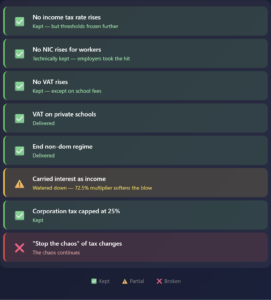
Two years in, Labour has delivered most of its explicit promises whilst, at the same time, breaking the spirit of its central pledge.
The “working people” whose taxes wouldn’t rise have seen employers’ NI increase their labour costs, fiscal drag pull them into higher brackets, and a raft of stealth taxes on property, savings, and pensions.
The wealthy, meanwhile, have voted with their feet. The Sunday Times counts them leaving and the Treasury counts on them staying. Only one of these counts will prove correct in the end.
The IHT changes were arguably the biggest unforced ‘error’. A policy that wasn’t in the manifesto, wasn’t demanded by the public, and united farmers, small business owners, and the guerrillas in the Telegraph comment section in furious agreement.
As mid-term report cards go, could do much better.
Definitely should have mentioned the tractor tax.
Next time…Reform UK and The £90 Billion Retreat
[1]DfE School Funding Statistics 2024-25: “On a per-pupil basis the total funding to be allocated to schools for 5-16 year olds, in cash terms, in 2025-26 is £8,210“. At 25,000 displaced pupils × £8,210 = £205 million
Published 1 October 2026
Read More
Published 23 September 2026
Read More
Published 17 September 2026
Read More
Published 5 September 2026
Read More
Published 30 August 2026
Read More
Published 18 June 2026
Read More