
CONFERENCE SEASON: THE TORIES TAKE AIM AT THE GRIEF TAX
Read more

May 20, 2026 | 5 min read
Author: Andy Wood
UK Tax Policy Mid-Terms: #2 Reform UK
Part 2 of 6 | The £90 Billion Retreat
Two years ago, I rather enjoyed Reform UK’s tax manifesto (sorry, “Contract with the People.”)
Indeed, I set out some of the bold ideas in my article: “Will Farage’s tax milkshake bring all the voters to the yard?”
Raise the personal allowance to £20,000.
Abolish IR35.
Slash corporation tax to 15%.
Cut the “Grief Tax” (their rebrand of IHT) for estates under £2 million.
Simplify the 21,000-page tax code to something approaching readable.
The problem with oppositions, of course, is that they eventually have to explain how they’d actually pay for things.
And in November 2025, Nigel Farage stood up and admitted they couldn’t.
Let’s be clear about what happened here.
Reform’s 2024 manifesto promised approximately £90 billion in tax cuts
Not spread over a decade.
Not subject to conditions.
A full-throated commitment to slash taxes across the board.
In November 2025, Farage announced: “We want to cut taxes, of course we do, but we understand substantial tax cuts given the dire state of debt and our finances are not realistic at this current moment in time.”
He called it a “mature” approach. Critics called it something else.
Richard Tice had been softening the ground at the party conference, talking about “performance related tax cuts”. In other words, ‘we’ll cut taxes after we’ve found the savings’. This is a rather different proposition from the original manifesto’s implicit promise that the tax cuts would generate the growth to pay for themselves.
So, what does Reform still believe? Let’s go through the wreckage.
Personal allowance to £20,000? Farage now says he “cannot give a figure at the moment.” He affirms it’s still an “aspiration” but won’t commit to when or whether it would happen.
Corporation tax to 15%?** No longer mentioned in recent speeches.
Abolish IR35? Still there. Farage called the rules “ridiculous” and said they’re “stifling innovation” and driving people into early retirement. This remains red meat for the contractor base.
IHT on family farms and businesses? Absolutely still committed. Farage has specifically pledged to “immediately remove IHT from family farms and from family-run businesses”, directly targeting Labour’s controversial tractor tax.
Tax simplification? Tice announced a working group to explore whether Britain’s 24,000-page tax code could be cut to around 500 pages. Hong Kong apparently manages with 300.
As such, it seems the flagship income tax and corporation tax cuts have been quietly shelved. IR35 and farm IHT remain. Simplification is being “studied.” (a worthy cause in itself).
If Reform was retreating on tax cuts, they needed something new to talk about.
In June 2025, Farage unveiled the Britannia Card. This was a one-off £250,000 payment that would give non-doms a ten-year renewable residence permit with favourable tax treatment.
No tax on international income, gains, or wealth. No inheritance tax. The fee would be redistributed “Robin Hood-style” to the 2.5 million lowest-paid workers.
It’s a bold pitch. Come to Britain, pay £250k upfront, and escape the tax regime that’s driving wealth overseas.
If tax cuts are out, spending cuts are very much in.
Farage has promised “the biggest benefit cuts you’ve probably ever heard any government do.”
The specifics seem to be:
Remove Personal Independence Payments from people with “non-major anxiety” — estimated £9 billion saved by 2029
There’s also a “broader absolute promise” to reduce the size of the public sector, including civil service cuts and a review of public sector pensions which are “a massive liability.”
Critics (including Kemi Badenoch) have pointed out the tension between Reform’s welfare-cutting rhetoric and their support for scrapping the two-child benefit cap. Farage has clarified this would only apply to “lower paid British couples who are both working”, a narrower policy than it first appeared.
What’s really happened to Reform is a shift from populist insurgents to would-be establishment.
In 2024, the pitch was: “We’re not like the others. We’ll actually cut taxes. We’ll actually simplify the system. We’re not captured by Treasury orthodoxy.”
In 2026, the pitch is: “We’re fiscally responsible. We won’t make promises we can’t keep. We’ll find savings before we cut taxes.”
This is, ironically, almost exactly what the Conservatives say.
Farage is explicitly attacking “hard left socialist dogma” and positioning Reform as the party of wealth creators: “I want as many high-earning people as possible living in this country and paying as much tax as they legally have to because if the rich leave and the rich don’t pay tax, then the poorer in society will all have to pay more tax.”
Reform’s tax U-turn has opened space on its right flank.
Rupert Lowe’s Restore Britain party (more on them in Part 6) is now offering what Reform used to promise. In other words, full IHT abolition, IR35 scrapped on day one, lowest corporation tax in Europe. No caveats. No “when finances allow.”
For voters who were attracted to Reform’s original tax-cutting radicalism, Restore Britain offers the undiluted version. The question is whether Reform’s pivot to “credibility” loses them more voters than it gains.
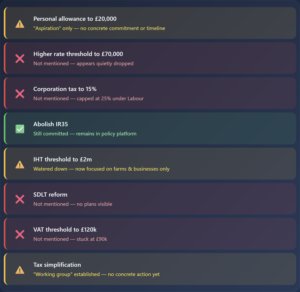
The party that promised £90 billion in tax cuts at the 2024 election now admits it can’t deliver them. The insurgent outsiders are now talking about fiscal responsibility.
The Britannia Card is a creative attempt to have something new to talk about, but it’s got more holes than a Swiss cheese factory.
What remains is IR35 (still ridiculous), farm IHT (still a vote-winner), and the vague promise that taxes will come down eventually, once the books are balanced.
It’s a long way from that 2024 election milkshake that was going to bring all the voters to the yard.
—
Next time: Green Party – Same Policies, New Leader
Published 1 October 2026
Read More
Published 23 September 2026
Read More
Published 17 September 2026
Read More
Published 5 September 2026
Read More
Published 30 August 2026
Read More
Published 18 June 2026
Read More