Taxing robots and the missing generation
Read more

October 16, 2026 | 14 min read
Author: Andy Wood
How Andy Burnham’s fiscal revolution put Yorkshire on the road to independence
By the time Andy Burnham won his second re-election landslide, nobody in England knew what their tax rate was.
That was not because the rates were secret.
Indeed, they were published in the UK’s state legislation, its 48 parallel county tax codes and 11 different models of double county tax agreements.
The issue was that your tax rate depended on many factors including, where you lived, where you worked, where your company was managed, where you sold your shares, where your house stood and, increasingly, where you might die.
However, we weren’t talking about complications of the internationally mobile elite. No, when I am talking about “where,” I am talking about where in the United Kingdom.
Well, what was left of it, anyway.
Of course, Scotland had already left the Union. Wales left shortly afterwards on it’s coat tails. However, in the case of the latter, no one really noticed.
The problem now was Yorkshire.
In Manchester, we had long heard that “we do things differently here”. The line from Leeds was less modest: “Yorkshire does everything better… including Manchesterism.”
It was an irritating slogan, made worse, if you were from the wrong side of the Pennines, by the facts and figures.
Yorkshire had the fastest growth in Europe. Leeds had single-handedly created an international shortage of construction cranes. Technology businesses were swarming to York. Family offices were nesting in Harrogate… and local people no longer thought a CSP was something you gargled with to soothe a sore throat[1].
How had this happened?
The government claimed it was the result of harmful domestic tax competition.
Yorkshire called it gumption. Tax gumption.
It had all begun sensibly.
Burnham had left the Greater Manchester mayoralty behind. But that experience had not left Burnham.
As mayor, he had seen the problem. Local leaders were responsible for transport, housing, skills and regeneration, but captured only a fraction of the direct fiscal return when those policies succeeded.
A new bus route could connect thousands of people to better-paid jobs. Greater Manchester might retain some of the resulting growth in business rates, and benefit from council tax generated by new development. But the additional income tax and National Insurance paid by those workers still flowed to Whitehall.
The region carried much of the cost and political risk of generating growth. The Treasury received most of the direct tax dividend[2].
When Burnham entered Downing Street, his first national plan was not to devolve tax rates or tax collection. Parliament would still set the taxes. HMRC would still collect them. The Treasury still redistributed money between richer and poorer areas.
The only change was that regions got to keep a share of the growth in the national taxes generated locally.
This was more a revenue assignment rather than real tax devolution. That said, “revenue assignment” was too long to fit comfortably on the side of a yellow bus.
The scheme worked.
Regions that built homes, improved transport and raised wages kept part of the resulting increase in income tax and business rates. Greater Manchester linked orbital bus services to hospitals, universities and key employment sites. The West Midlands invested back into its manufacturing base. The Northeast matched training to local employers.
Even the Treasury benefited. The regions kept some of the growth. Whitehall received the rest.
Everyone was a winner.
Better transport led to better jobs. Better jobs led to higher wages. Higher wages led to more tax. More tax paid for better transport.
The Manchester Formula was born.
After Burnham’s first general election victory as Prime Minister, the scheme was expanded.
Regions received a larger share of locally generated tax growth, multi-year budgets and the ability to borrow prudently against future receipts.
Departmental pots for transport, skills and housing were consolidated into regional settlements.
Again, Burnham’s plans worked.
Employment rose. Development accelerated. The regions became less dependent on annual bidding rounds in which councils competed to demonstrate that they were both uniquely deprived and ready to deliver immediately.
Success produced the next big national debate.
Regional leaders were spending tax revenues without setting the taxes. They could take credit for services while blaming Westminster for the bill.
A Royal Commission was appointed to examine the “fiscal accountability gap”. The report ran to 612 pages.
It recommended limited local variation within a common national framework. It also, rather unfortunately a bit too near to the end of the report, warned that separate tax bases, aggressive rate competition and fragmented collection could undermine the success of the original model.
Burnham was totally sold upon the plan after reading the pithy analogy in the executive summary: “The authority that drives the local economy should accept responsibility for setting the fare.”
He need read no further.
Burnham’s second re-election produced a landslide and, with it, the Fiscal Counties Act.
The national tax system was split in two.
There would be State Income Tax, State Corporation Tax, VAT and national social contributions. On top of those, each county could impose and retain its own Income Tax, Corporation and Capital Gains Tax and Inheritance Tax.
Further, property taxation was devolved completely. Counties could tax property when it was bought, tax it annually while it was owned, impose both taxes or impose neither.
At first, the reform was broadly revenue-neutral. State rates were reduced and every county adopted a standard local schedule to fill the gap. Nobody paid more on the first day.
HMRC collected the county taxes during the transition. Later, counties could create their own revenue authorities or subcontract it to a local private company.
The Home Counties used their new powers to protect services.
Surrey imposed a County Income Tax, retained stamp duty and introduced an annual Prosperity Property Contribution.
London did both, then created a supplementary levy to administer the first two.
Buckinghamshire established a Green Belt Preservation Charge, most of which was spent determining which parts of the Green Belt required preserving from the tax.
Greater Manchester abolished stamp duty and introduced an annual Civic Property Contribution. Homes close to a Bee Network stop paid more because they benefited from it. Homes without a nearby stop also paid more to finance its extension.
Yorkshire took a different view.
Yorkshire had studied Texas and Florida. It noticed that the power to impose a tax did not create a duty to do so.
County Income Tax was set at zero. County Capital Gains Tax was fixed at 10 per cent. County Inheritance Tax was abolished. (Note – Supporters had wanted to run a campaign with the slogan “Dead, but wi nowt taken out”. However, in a rare display of tact, it was decided to be in poor taste)
Yorkshire imposed no stamp tax and no annual property tax.
It’s residents still paid State taxes. The county had not abolished taxation. It had merely declined to add very much more of it.
A Guardian columnist sneeringly called it “Singapore-on-Wharfe”. It was meant as an insult.
By lunchtime, the Yorkshire Investment Agency had registered the domain name. By teatime[3], the phrase appeared beneath the white rose on every inward investment brochure.
The effects were transformative.
Founders established genuine Yorkshire residence, bringing their gains with them, before selling companies to lock in the 10% CGT rate. Senior executives moved their homes and management functions north. Developers built around Leeds, York and Harrogate. Professional services followed their clients.
Google moved its UK headquarters to Leeds.
Nvidia selected York.
Goldman Sachs chose Harrogate.
Skipton Building Society, following an exhaustive review, kept its headquarters in Skipton.
Yorkshire counted all four as inward investment successes.
Its tax authority published 48 pages of legislation and guidance (including the index). The principal anti-avoidance rule provided a limitation of benefits to anyone “taking the Mick”. The penalty being a ‘clip round the ear”
In a seminal tribunal case, a brass[4] plate in Leeds, a quarterly board meeting at Betty’s and the ceremonial purchase of a flat cap were held, on balance, to be insufficient (the court setting out the appropriate multi-factorial test).
Real people and real activity had to move…
… and, by gum, they did.
Some of Yorkshire’s growth was new. Lower transaction costs encouraged movement and development. Lower personal taxes attracted talent. Stable rules and certainty reduced the cost of compliance and gave confidence to investors.
Inevitably, some of it came at other’s expense.
The Home Counties lost founders, executives and wealthy retirees while retaining schools, roads, social care and other spending commitments built around their former tax base.
Surrey repeatedly raised its rates to replace the missing revenue.
More taxpayers left.
“Let them go” and “I’ll drive them to Watford Gap Services myself” were the typical social media responses.
Surrey raised rates again to replace the revenue lost when the first group left.
The process became known as the Surrey Spiral.
Meanwhile, Yorkshire did acquire problems of its own. House prices rose. Infrastructure was put under pressure and struggled to keep up. Young Yorkshire residents discovered that inward investment often arrived in the form of someone from Esher offering cash for the house they were trying to exchange on.
Even worse, the tax profession proliferated.
A person could live in Buckinghamshire, work in London, manage a company from Leeds and own property in York. The State Tax position was straightforward. Everything else required an ordinance survey map and a formal tax opinion.
The government described the entire process as a race to the bottom.
Yorkshire replied that this was generally how the person at the back described a race. It added that “Winners can laugh, and losers can please themsens.”
[Fast forward]
Turmoil engulfed the Union. The taxation of freight routes to the outlying fiscal counties was in dispute.
The Lancashire Trade Federation, complaining that Yorkshire’s low-tax regime amounted to an unlawful subsidy, blockaded Ainley Top and halted the free passage of Yorkshire goods towards the western counties.
Parliament debated whilst Yorkshire lorries queued.
Burnham dispatched two senior Treasury envoys to negotiate an end to the blockade. The Federation declined to receive them and refused to validate their parking ticket.
Something had to be done.
This was the first time in his long tenure as Prime Minister that Burnham found himself on the back foot.
His fight back was the Union Minimum County Tax (“UMCT”).
The model was simple. Any income (whether personal or corporate) or capital gain or transfer taxed by a county at less than 25 per cent would suffer a top-up to 25 per cent, payable to the State.
Yorkshire could keep its zero income tax and 10 per cent capital gains tax if it liked.
However, its residents would simply pay the balancing amount to Westminster.
Burnham insisted that his manifesto promise of county sovereignty, and his devolution dream, remained intact. Counties could still choose their own rates. The driver was still setting the fare.
Yorkshire pointed out that the only remaining choice, however, was who received that fare.
Burnham said devolution came with responsibilities.
He accused Yorkshire of abusing Manchesterism.
Leeds repeated its famous reply that “Yorkshire does everything better, including Manchesterism.”
The historical point was, of course, awkward. The original Manchester School had believed in free trade, competition and resistance to excessive taxation.
Burnham’s Manchesterism seemed somewhat more interventionist, with four wheels and painted yellow.
Only Yorkshire appeared to have read the original Manchester prospectus.
By then, buses had moved from being a policy to becoming the organising principle of government.
In Burnham’s first term, the bus had been a practical and simple means of connecting people to jobs.
In his second, it had become a metaphor for the state.
By his final term, it was becoming clear that he was no longer simply speaking metaphorically.
In retrospect, the signs had always been there.
There were the early social media interventions on barms, baps, buns and stotties.
Then, there had always been Everton.
His devotion to the club had, of course, cultivated the qualities that later defined Manchesterism. Loyalty, optimism, public ownership of disappointment and a complicated relationship with adverse data.
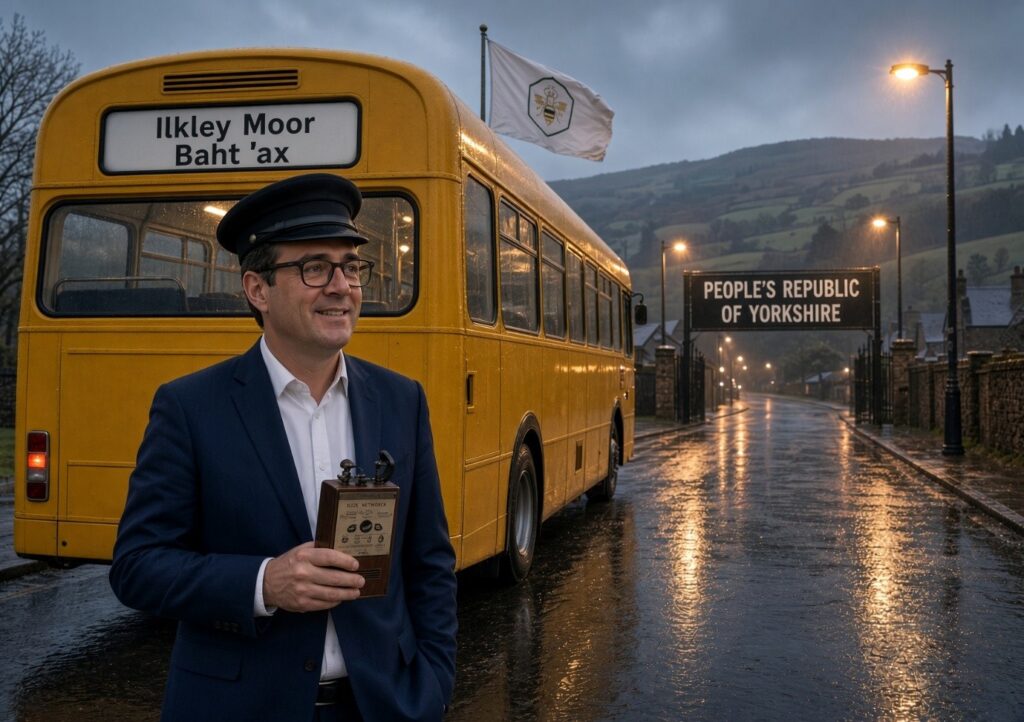
After his final election victory, Burnham appeared outside Downing Street wearing a bus conductor’s hat.
His advisers said it had been presented during the campaign and that he wore it to keep off the rain.
However, this explanation became less convincing when he produced a ticket machine…
… and demanded to be called the Prime Conductor.
As we have seen, Scotland and Wales had already become independent of the United Kingdom.
Taking advantage of an incapacitated Burnham, Yorkshire had successfully called for its own referendum.
The question on the balance paper was carefully designed to reflect Yorkshire’s linguistic and constitutional traditions:
What should Yorkshire say to independence, full control of its own brass and freedom from those southerners and it’s Union Minimum County Tax?
“AYUP” – meant saying hello to independence, fiscal sovereignty and withdrawal from the Minimum Tax.
“SITHEE” – meant saying goodbye to independence, remaining in the Union and carrying on doing what them southern softies told us.
The UK’s Electoral Commission objected that the question was leading, that the response options were insufficiently formal and that “them southern softies” was not a neutral description of the national government.
The newly formed Yorkshire Electoral Commission considered those observations carefully. It then told the Union Electoral Commission “sithee.”
Yorkshire voted “ayup”.
The People’s Republic of Yorkshire was born.
—
Life settled quickly in the People’s Republic of Yorkshire.
The queues at Ainley Top disappeared. The white rose flew over the old county halls. Revenue Yorkshire was elevated, without any apparent irony, into the Ministry of Brass.
The Republic’s first Budget confirmed that taxes would remain low, rules would remain short and reliefs would remain few.
Every new tax had to identify, in plain language, the thing being taxed, the reason for taxing it and the person expected to pay it.
For every new tax provision introduced, two needed to be repealed.
Not that it had ever been in particularly short supply, but Yorkshire patriotism flourished. Every morning, schoolchildren stood beneath the white rose flag. Every new citizen applying for a Yorkshire tax number made the same pledge.
It was known formally as the Responsible Yorkshire Citizen’s[5] Motto:
’Ear all, see all, say nowt;
Eyt all, sup all, tax nowt;
An’ if ivver tha makes owt from nowt,
Allus book t’gain here, fer Yorkshire.
[Revenue Yorkshire later clarified that “tax nowt” was a broad statement of government policy, not an invitation to individual non-compliance.]
Burnham had taught Yorkshire a valuable lesson. That lesson was to set its own fare…
…however, he had simply never imagined that they would also drive the bus all the way out of the Union
Note to readers – this is (an attempt at) satire. It is just for fun. No offence is intended (other than that aimed at Lancastrians).
[1] Ok, my dad might have been the only person who gargled with TCP. Do not try this at home.
[2] Technically, Greater Manchester already operated an enhanced business-rates retention arrangement. The initial settlement was designed to be cost-neutral, with additional retained rates matched by grants forgone and adjustments to tariffs and top-ups. The real prize was the ability to keep more of the subsequent growth.
[3] Yes. This is the correct terminology for an evening meal as determined by the Yorkshire Mealtime (Standardisation) Act 2033.
[4] Thwarted in their earlier efforts around IHT, Revenue Yorkshire finally instigated an award-winning campaign entitled “Where there’s brass (plates); there’s muck” as a warning against such tax abuse.
[5] For inclusivity reasons, it was unanimously decided to change this from being called the Yorkshireman’s motto.

Published 1 October 2026
Read More
Published 23 September 2026
Read More
Published 17 September 2026
Read More
Published 5 September 2026
Read More
Published 30 August 2026
Read More