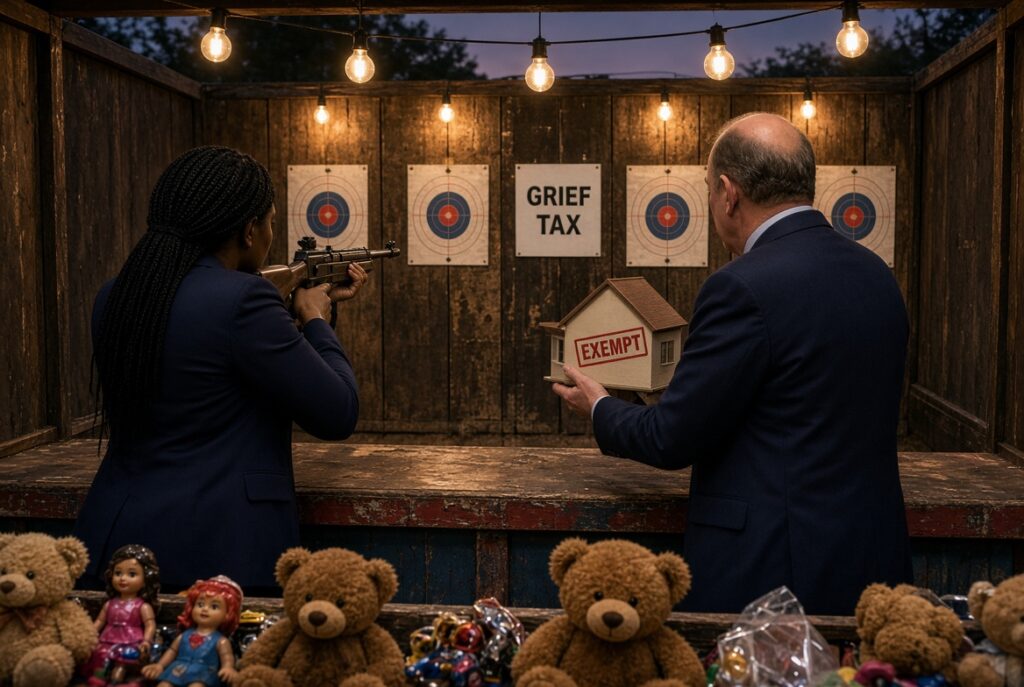
CONFERENCE SEASON: THE TORIES TAKE AIM AT THE GRIEF TAX
Read more
September 27, 2026 | 8 min read
Author: Andy Wood
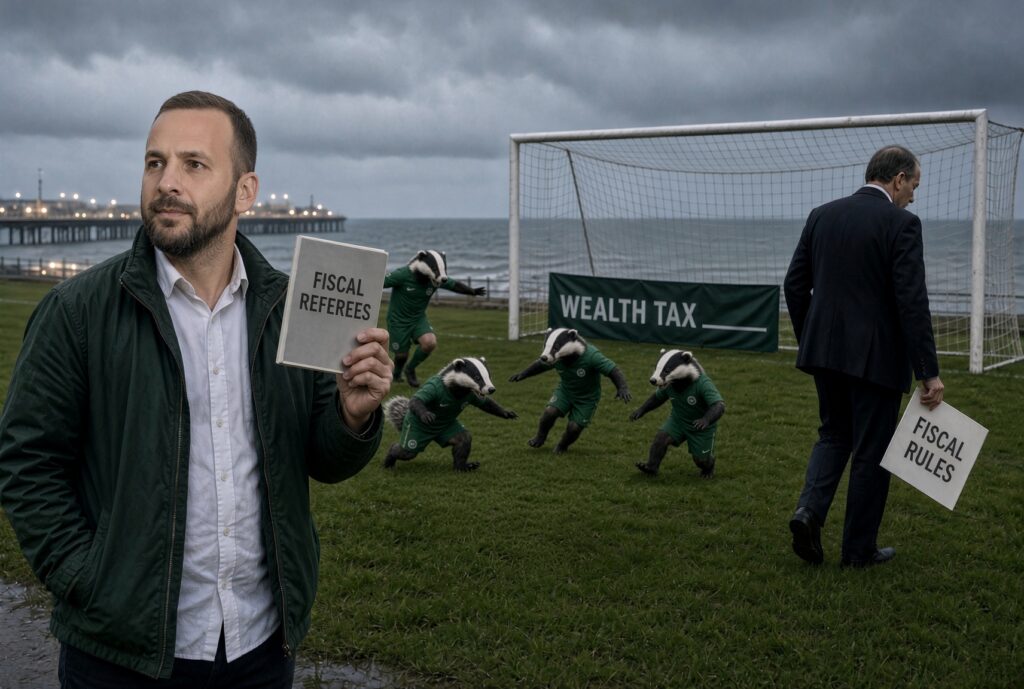
In which the badgers retain their enthusiasm for taxing wealth, Zack Polanski takes aim at bank profits, and conference decides the rules of the economic game need rewriting.
My May mid-term report on the Greens was called ‘New Leader, Same Badger Budget’.
Zack Polanski had sharpened the sales pitch. My questions about the tax machinery remained much as they were. Wealth, capital gains, pensions and carbon had all been identified as promising places to find money. The practicalities had not become less awkward simply because the slogan was better. [1]
After the October conference in Brighton, I need to amend that verdict.
The badgers still want to tax wealth. But they also want a different referee.
Polanski’s leader’s speech reiterated a tax on extreme wealth and a windfall tax on bank profits. It did not set out a new schedule of wealth-tax rates, thresholds or valuation rules. [2]
In May, I recorded the party’s previous wealth-tax proposal as 1% on wealth above £10 million and 2% above £1 billion. Those were the figures I scrutinised then. The conference speech did not supply a fresh worked design against which to replace that analysis. [1, 2]
That distinction matters. Repeating support for a wealth tax is not the same as resolving the difficult questions about one.
What counts as wealth? How are private businesses valued? How do you distinguish a valuable asset from cash available to pay an annual bill? What happens to trusts, debts and assets spread across countries?
These are not objections invented by someone struggling to remember where he left his offshore account passbook. They are the questions that any legislation would have to answer.
Take a founder whose company is valuable on paper but generates little distributable cash. A wealth-tax liability might require dividends, borrowing or a sale. A deferral mechanism can soften that problem, but then the revenue arrives later and the government acquires another collection risk.
You can decide that the resulting trade-offs are worthwhile. You cannot remove them by increasing the vigour with which you bash the lectern with your fist.
The other substantial items in my May report were equalising capital gains tax with income tax, extending the main employee NI rate above its current upper limit, restricting pension tax relief to the basic rate, and a steeply rising carbon tax. [1]
Those are significant changes for investors, employees and savers, quite apart from the billionaires in the headline. The keynote did not provide a replacement package for them. I would not mistake that silence for either a withdrawal or a fresh, detailed commitment.
A bank windfall tax has an obvious political attraction. Very few conference delegates are going to interrupt the speech to ask whether the banking sector has had enough emotional support.
The technical question is what makes a profit a windfall.
Is the charge aimed at a temporary gain from a particular economic event? Is it calculated against a normal-profit baseline? Does it interact with existing corporation tax and sector-specific charges? When does it end?
If the answer to the last question is ‘never’, we are discussing a permanent additional tax on banking, whatever name appears on the banner.
That may still be a policy the Greens want to defend. But a permanent spending commitment needs a durable funding source. A genuinely temporary windfall cannot be spent again next year simply because the public service remains popular.
The more significant development came with the economic framework members backed on 4 October.
It would replace rigid fiscal rules with fiscal referees and judge policy more directly against social and environmental objectives, rather than prioritising GDP growth. [3]
The framework also proposes greater public control of banking, a public retail bank and a network of local and regional banks. It envisages less reliance on interest rates alone to control inflation and changes to government bond issuance. [3]
That is a larger ambition than moving a tax rate up a couple of points. The party wants to change how spending decisions are constrained and how finance reaches the economy.
It is also where the tax debate becomes more interesting. If a government borrows more to invest, the immediate tax requirement may differ from a programme funded entirely out of current receipts. But the borrowing still needs financing, the investment still needs resources, and its future returns still matter.
A different framework can change the decision. It cannot guarantee that every desired project becomes affordable.
There is a lazy response to all this. And that might be that anyone questioning the fiscal rules must want unlimited spending.
But that is, as I say, lazy.
In February, the Institute for Fiscal Studies proposed a broader framework of fiscal traffic lights in place of the current pass-or-fail approach. Its argument was that obsession with a narrow measure of forecast headroom can produce bad decisions. It also warned against an immediate switch in fragile market conditions. [4]
That is not an endorsement of the Greens’ programme. It does demonstrate that asking whether the rules work is a serious question.
A government can meet a rolling numerical target by pencilling in implausible decisions for a future year. Passing that test is not the same as having a convincing plan.
Equally, a government can call something investment without making it productive. A disappointing project does not become a national asset simply because the Chancellor has selected the capital-spending column.
The right argument is about the quality of the constraint and the decisions it encourages. It is not a contest to see who can say ‘fiscal credibility’ most solemnly.
Which brings me back to the Greens’ proposal.
Who appoints the referees? What do they assess? Can ministers overrule them? What is published when the Government disagrees? What happens when environmental and social ambitions collide with inflation, borrowing costs or a shortage of skilled workers?
Those are the questions which would tell us whether the replacement framework is a better discipline or simply an easier one.
The real economy supplies constraints regardless of the accounting rules. If the workers, materials or productive capacity are unavailable, additional public spending can bid up prices instead of delivering the intended output.
Tax can affect that balance as well as raise money. Who is taxed, how they respond and when the revenue arrives therefore remain central questions, even in a framework less preoccupied with a particular borrowing target.
Changing the referee does not make the pitch or goals any bigger.
Polanski also proposed a three-year rent cap, with annual increases limited to the lowest of inflation, wage growth or 2%, followed by a fair-rents guarantee. [2]
Whatever one thinks of it, a rent cap is regulation. It is not a tax cut, and it should not be entered into a tax scorecard as though HMRC were writing tenants a cheque.
The distinction becomes important when lower household costs are treated as though they automatically create money for other public spending. A saving to a tenant and an extra receipt for the Treasury are different things.
The same care is needed with the speech’s criticism of public money flowing to private landlords through housing benefit. [2] Replacing that system requires homes to be available through an alternative. You cannot spend the saving from a completed transition before paying for the transition itself.
| Policy | My mid-term verdict | After conference |
| Wealth tax | Big claims; difficult valuation and liquidity questions | Reaffirmed, without a new worked design in the leader’s speech |
| Bank taxation | Not separately assessed in my May report | Windfall tax reiterated; base and duration need definition |
| CGT, NI, pensions and carbon | An ambitious and contentious inherited menu | No replacement rate schedule in the keynote; silence is not repeal |
| Fiscal framework | Revenue proposals were the main focus of my review | Members endorsed fiscal referees and a different approach to economic goals |
| Practical delivery | The mechanics needed more attention | The institutional ambition is larger; the implementation questions remain |
The Greens have done more than reheat their wealth-tax slogan. Conference endorsed an attempt to change the framework in which tax, spending and borrowing are debated.
There is a legitimate argument to be had about that framework. I would rather examine it than pretend the current rules arrived on stone tablets.
But my May criticism still applies to the tax proposals themselves. Identifying somebody with a large personal balance sheet is the beginning of designing a tax, not the end. Nor does replacing a fiscal rule answer the questions about collecting the money.
The badgers have broadened their ambitions.
I am still waiting for the tax workings. And, now, the referee’s rulebook.
—
[1] Breaking Tax, UK Tax Policy Mid-Terms #3 Green Party, 28 May 2026
[2] Green Party, Zack Polanski conference speech, 2 October 2026
[3] Green Party, economic framework adopted by conference, 4 October 2026
[4] Institute for Fiscal Studies, From fiscal rules to fiscal traffic lights, 19 February 2026
Published 1 October 2026
Read More
Published 23 September 2026
Read More
Published 17 September 2026
Read More
Published 5 September 2026
Read More
Published 30 August 2026
Read More
Published 18 June 2026
Read More