
(NON) CONFERENCE SEASON: RESTORE BRITAIN SHARPENS THE TAX AXE
Read more

September 17, 2026 | 6 min read
Author: Andy Wood
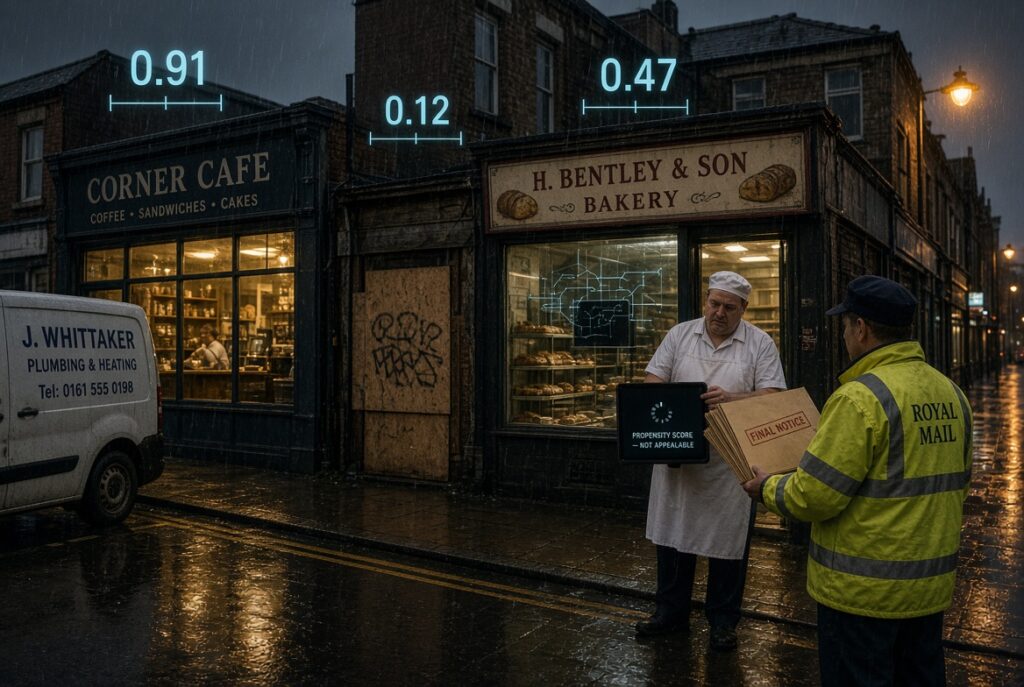
There’s an episode of Black Mirror where everyone has a social rating. Smile enough at strangers, and you get a nicer apartment. Frown at a barista, and suddenly you can’t rent a car. It was terrifying because it felt five minutes away from reality.
Well, congratulations. For four million UK businesses, it’s not five minutes away. It’s here.
Last week, tucked between HMRC’s request to raid your bank account and its proposal to jail you for “reckless” mistakes, PublicTechnology quietly reported something extraordinary…
… HMRC is using machine learning to score every business in Britain on their “propensity to pay” tax debts.
Read that again. Every business. Scored monthly. Zero to one. Like an Uber rating, except instead of a 4.2-star driver losing access to surge pricing, a low score means HMRC sends you different letters. Nastier letters.
The algorithm, developed during COVID, analyses your “past debt-repayment behaviour.” It feeds on your VAT returns, PAYE submissions, Corporation Tax payments. Basically, every interaction you’ve had with the Revenue since records began.
Oh, and you cannot appeal decisions made by the tool.
HMRC says the score is “just one factor” in how they treat you. They also say they can’t tell you what your score is or how it’s calculated.
Black box stuff.
Let’s be clear about what’s happening here. In the space of a few weeks, HMRC has revealed:
The contrast is delightful.
The same organisation that cannot debug its own software… and for five years… has somehow found the resources to build a machine learning model that profiles every business in Britain. Priorities, ladies and gentlemen.
HMRC estimates there are approximately 6 million businesses in the UK. They’re scoring 4 million of them.
That’s two-thirds of every company, partnership, and sole trader in Britain, rated on a zero-to-one scale they can’t see, based on criteria they can’t know, with no formal appeal mechanism.
If you’re thinking that this effectively sounds like credit scoring, then you’re right.
Except credit scores are regulated by the FCA, subject to data access rights, and you can see them. HMRC’s propensity score? None of the above.
And what happens to the businesses with low scores? They “receive different communications.”
In HMRC-speak, that means earlier intervention, more aggressive recovery action, and the assumption, baked into the algorithm, that you’re not going to pay unless forced.
Guilty until innocence proved.
The bank account access proposal pairs beautifully with this. Consider the workflow:
This isn’t merely a slippery slope argument. These are all real proposals and real systems, operating now or coming to a HMRC regional centre near you.
The thing about surveillance infrastructure is that it requires trust. And HMRC very much has a trust problem.
The five-year bug affected 107,000 people. Not edge cases. Not exotic tax situations. Bread-and-butter calculations that were simply wrong… for half a decade… affecting six-figure numbers of taxpayers.
Nobody was fired. No heads rolled. The bug was eventually fixed in 2024 and HMRC quietly acknowledged it.
Now they want:
You can see why businesses might be nervous.
Speaking of nervousness, let’s talk about pensioners.
The government announced in 2024 that from April 2027, unused DC pensions and death benefits would count toward IHT estates. A policy that hasn’t even kicked in yet. And already, £1.4 billion in “retirement risk” decisions have been made. We are told that pensioners are panic-withdrawing from their pots to gift or spend before the rule takes effect.
This is what economists call “the announcement effect.” You don’t need to implement bad policy to cause damage. You just need to announce it.
The result? People gambling their retirement security against potential tax savings. Depleting pension pots at 67 because they’re terrified of a rule that starts in 2027… and might change again before then.
Who wins? Tax planners. Financial advisers. Estate lawyers.
Who loses? The pensioner who miscalculates and recklessly lives to 95.
Let’s be nuanced for a moment.
HMRC does need enforcement tools. The tax gap is real, with somewhere between £30-40 billion annually, depending on how you count.
And some taxpayers are gaming the system, dragging out disputes while keeping cash in their pockets.
But there’s a difference between needing better enforcement and the construction of an opaque AI system to profile every business in Britain… while also taking direct debit powers… criminalizing mistakes… and apparently being unable to properly operate a calculator for five years.
The propensity scoring might even be reasonable, if it were transparent, auditable, and subject to appeal. Credit scores work because you can see them and challenge errors. HMRC’s system is a black box by design.
So, where does all of this leave us?
HMRC wants you to trust it with unprecedented powers. Direct access to your bank account. Criminal penalties for unintentional errors. An AI that rates your willingness to pay taxes.
Meanwhile, they can’t fix a bug for five years, their announced policies are causing billions in panic decisions before implementation, and the wealthy they’re targeting are simply… leaving.
If this were a business, you’d call it a strategy problem. When your enforcement infrastructure gets more sophisticated but your biggest targets keep flying to Athens, you’re not tightening the net… you’re just making life harder for everyone who can’t leave.
Welcome to Britain’s business social credit system. Please wait. Your propensity score is loading.

Published 1 October 2026
Read More

Published 23 September 2026
Read More
Published 5 September 2026
Read More
Published 30 August 2026
Read More

Published 18 June 2026
Read More