
ON ILKLEY MOOR BAHT ‘AX
Read more

September 23, 2026 | 8 min read
Author: Andy Wood
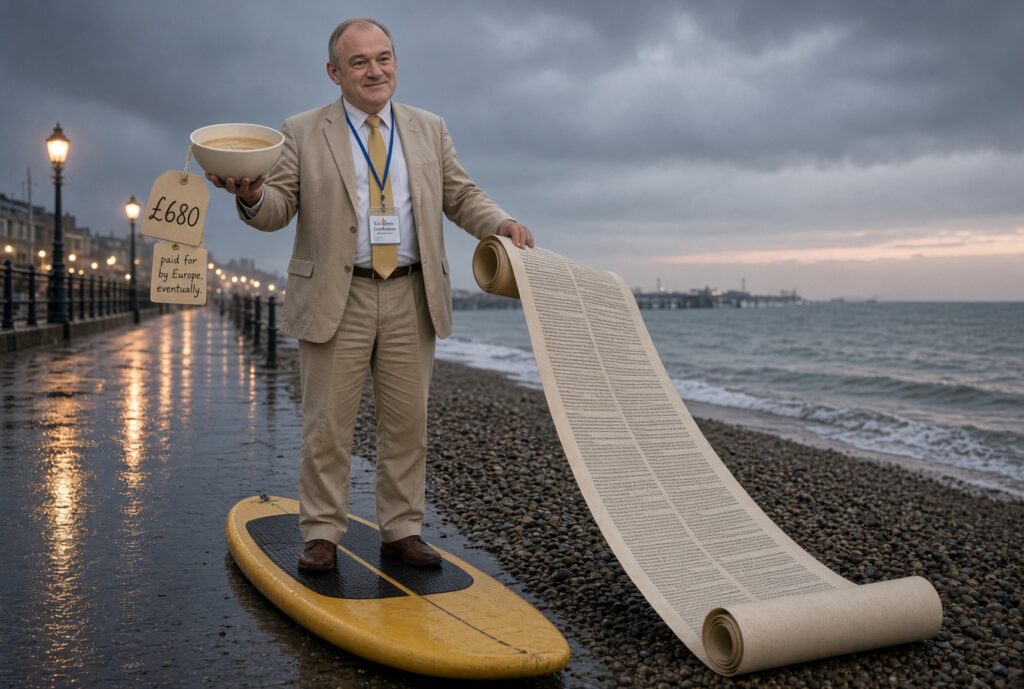
In which Ed Davey produces an actual number, the personal allowance acquires a European funding plan, and the small print does a little bit more work than the paddleboard.
Back in June, I described the Liberal Democrats as ‘still beige after all these years’. Their tax policy was miso soup. Warm. Inoffensive. Unlikely to cause a scene at the dinner table.
My particular complaint was that they wanted to raise the personal allowance but would not say by how much, or how they would pay for it. ‘Reform CGT fairly’ was similarly doing sterling service as a substitute for an actual policy. [D1]
Well, credit where it is due. At their September conference in Brighton, the Lib Dems supplied some numbers.
The soup now has a price tag. Whether the kitchen can deliver it is another question.
Davey’s package would raise the personal allowance and employee National Insurance threshold to £15,000 within five years.
The higher-rate income tax threshold would rise to £56,000, with the additional-rate threshold moving to £130,000.
The party says 2.5 million people would leave income tax altogether and 760,000 would escape the 40p band. [D2]
That is a substantial improvement on ‘we will increase it by an amount we will tell you about eventually’.
It also addresses something my mid-term series kept coming back to… fiscal drag.
In other words, freeze the thresholds, let wages rise, then collect more tax without touching the headline rates. A tax increase in an invisibility cloak.
The current legislation keeps the main income tax allowance and basic-rate limit frozen through 2030/31. Breaking that freeze would therefore be a real change. It would not merely be a new name for something the Treasury was already planning to do. [D3]
The headline saving is £680 a year for millions of people. It is not a £680 cheque for everyone. [D2]
For an employee paying the 20% basic rate and 8% employee NI across the relevant slice of earnings, the numbers are straightforward. An extra £2,430 of tax-free income saves £486 of income tax. The matching NI change saves another £194.40.
Total = £680.40. [D4]
A basic-rate pensioner above State Pension age pays no employee NI. The allowance increase could save them £486 in income tax, provided they have enough taxable income, but it does not manufacture the missing NI saving. [D4]
Someone already earning below the existing allowance gets no direct income tax saving from increasing it. Someone only a little above it gets less than the headline amount.
Scotland also has its own income tax bands and rates for earnings, so the income tax calculation cannot simply be caber tossed across the border. [D4]
None of that makes the policy bad. It makes ‘millions could save this much’ a different proposition from ‘everyone will save this much’.
There is a less photogenic detail.
The personal allowance currently starts disappearing once adjusted net income exceeds £100,000, at £1 for every £2 above that level. That produces the familiar (by familiar, think creepy uncle) effective 60% income tax band for relevant earnings in England, Wales and Northern Ireland. [D4]
If the allowance rises to £15,000 and that withdrawal rule stays put, the taper stretches to £130,000. You need £30,000 of additional income to lose a £15,000 allowance at that rate.
The party’s proposed additional-rate threshold fits those numbers [D2] But the uncomfortable consequence is that a bigger allowance can extend the range of income exposed to the 60% marginal rate. The tax trap has been dug a little bit deeper.
To be fair, Cooper’s growth paper recognises the problem of perverse marginal rates and tax cliff edges. It does not yet provide a costed remedy. [D6] The final package needs to join those dots, rather than make one part of the system more generous while leaving this ugly goblin to its own devices.
The party cites a House of Commons Library estimate of £17 billion for the package in year five.
Its funding case is a closer European partnership, including single-market and customs-union membership, which it estimates would add £27 billion a year to tax receipts by the end of the next Parliament. [D2]
This is more informative than the June position. We can now see both the intended tax cut and the economic argument meant to support it.
But an economic argument is not cash already sitting in the Exchequer’s account.
A European agreement would require negotiation. Businesses would need to respond. Extra activity would need to become taxable profits, earnings and consumption. The timing matters as much as the eventual estimate.
You can legislate for a tax threshold. You cannot legislate for the precise amount of growth you would like to fund it.
Nor can the same growth dividend simultaneously fund every attractive spending commitment.
Before this becomes a governing programme, I would want a year-by-year bridge between the cost of the cuts and the receipts expected to pay for them, including what happens if those receipts arrive late.
That is a request for a timetable and a contingency plan. It is not an argument that closer trade (nothwithstanding the wider political cauldron this will stir) cannot make the country richer.
Daisy Cooper’s growth paper proposed a single digital entry point for businesses dealing with tax, regulation and legal requirements, alongside a ‘Tell Us Once’ approach. [D5]
Anyone who has supplied the same information to three public bodies, in three formats, with three different passwords, can see the attraction.
But a single website does not make the rules behind it simpler. If the portal still leads to overlapping obligations and contradictory definitions, all we have done is put a new reception desk and soft furnishing at the entrance to the labyrinthe.
The conference coverage also recorded proposals to restore the Office of Tax Simplification and examine property taxes through a commission.
The business motion backed lower employer NI for young and part-time workers. The broader growth paper was a spokesperson’s paper, rather than a complete package adopted by conference. [D6]
Those distinctions matter. A motion is a political commitment. A paper may contain useful proposals. However, neither tells an employer exactly what next April’s payroll will cost.
In June, I described the positioning as taxing banks rather than pubs and farmers. The underlying electoral calculation has not become difficult to recognise.
Davey criticised Labour’s mansion-tax approach in his conference Q&A, while the party continued to oppose the farm and family-business inheritance tax changes. [D6]
There may be sound objections to each policy. But a party which wants fairer property taxation eventually has to explain which property owners it is prepared to send a larger bill to.
‘A commission will look at that’ is a perfectly respectable beginning. It is also, politically, a very comfortable place to stop.
There was a more immediate motoring offer including a temporary 10p fuel-duty cut until at least Christmas (a strange commitment in which they are seemingly cosplaying being the current government!), and a cut in VAT on public electric-vehicle charging. A 10p duty reduction could translate into 12p at the pump once VAT is included… assuming it is passed on. [D7]
| Policy | My mid-term verdict | After conference |
| Personal allowance | An increase with no number attached | £15,000 target; a material improvement in specificity |
| Funding | Unclear | European growth dividend; delivery and timing still need testing |
| Fiscal drag | Criticised more readily than solved | Explicit increases in the main thresholds |
| Business tax | Sensible but fuzzy | Administrative proposals and targeted NI relief; detail still developing |
| Property and inheritance | Defending sympathetic taxpayers | Opposition remains clearer than the replacement settlement |
I cannot spend June complaining that a party refuses to give me a number and then complain in September that it has given me one.
The Lib Dems have moved the dial a little. The personal tax package is clearer, the attack on fiscal drag is substantive, and the funding argument can now be examined rather than guessed at.
There are still loose ends. The allowance taper needs attention. The European receipts need a credible timetable. The business proposals need to become a coherent set of rules.
But, as I say, some progress.
The soup remains miso. This time, somebody has written down the ingredients and told us what they think dinner will cost.
We just need to know how and when it will be served.
—
[D1] Breaking Tax, UK Tax Policy Mid-Terms #5 Liberal Democrats, 5 June 2026
[D2] Liberal Democrats, Davey conference speech and detailed notes to editors, 22 September 2026
[D3] Finance Act 2026, section 10, income tax threshold freeze
[D4] HMRC, Budget 2025 rates and allowances; calculations in the article are illustrative
[D4] HMRC, National Insurance rates and liability
[D4] HMRC, National Insurance overview and State Pension age exemption
[D4] GOV.UK, Scottish Income Tax
[D5] Liberal Democrats, Cooper growth plan announcement, 19 September 2026
[D6] Chartered Institute of Taxation, Liberal Democrats conference tax report, 27 September 2026
[D7] Liberal Democrats, tax and fuel-duty announcement, 20 September 2026


Published 1 October 2026
Read More
Published 17 September 2026
Read More
Published 5 September 2026
Read More
Published 30 August 2026
Read More