
(NON) CONFERENCE SEASON: RESTORE BRITAIN SHARPENS THE TAX AXE
Read more

August 30, 2026 | 9 min read
Author: Andy Wood
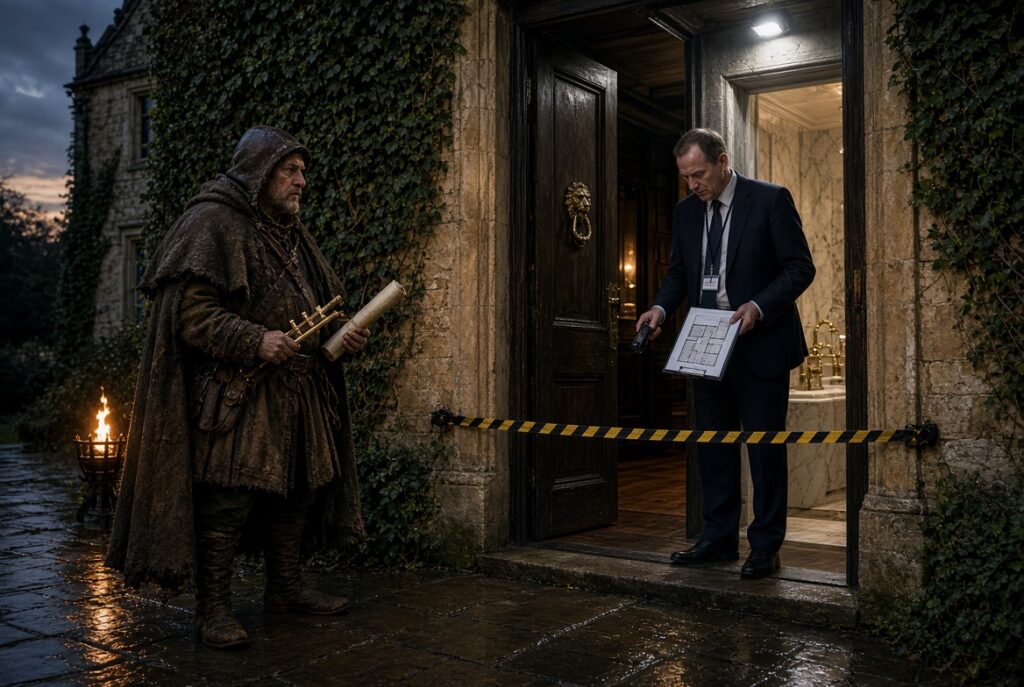
In which we learn that counting bathrooms in 2026 and lifting skirts in 1381 have more in common than the Treasury might like to admit.
Earlier in the month, the Sunday Telegraph broke a story that had Middle England reaching for the smelling salts.
It described Labour’s planned “mansion tax”, or to give it its posh name, the High Value Council Tax Surcharge. We were told in the article that it would be enforced by HMRC inspectors who would have the power to demand entry to your home.
That’s right. Demand entry.
The taxman, inside your house. Counting your bedrooms. Measuring your bathrooms. Assessing your “architectural style.” All to determine whether your pile is worth £2 million or more, and therefore subject to an annual levy of up to £7,500.
Refuse entry? That’s potentially a £200 penalty. Fail to provide information? £500. Lie about it? Up to three months in prison.
The then Shadow Chancellor Mel Stride called it a “sinister assault on civil liberties.” Sir James Cleverly described it as “HMRC tax inspectors snooping around their gardens and inside their homes.”
The Treasury, naturally, said visits would be “arranged in advance” and conducted “in line with official guidelines.”Well, that’s alright then.
Because if there’s one thing that reassures the British public, it’s government inspectors with statutory powers of entry who promise to be polite about it.
Here’s the thing about sending tax collectors into people’s homes with powers of compulsion: we’ve tried it before.
It did not end well.
The year was 1381. Black Death had recently killed a third of Europe’s population… not 0.05% as with COVID, but thirty-three percent. Of everybody.
This left a rather inconvenient shortage of people to work the land. The survivors, recognising the value of their suddenly-scarce labour, began demanding higher wages.
The government, being composed primarily of landowners, responded to this outbreak of basic supply-and-demand economics with characteristic grace. They introduced a National Maximum Wage. They made refusing to work for that wage an imprisonable offence.
And then, because medieval fiscal policy was nothing if not consistent, they levied a poll tax.
The third poll tax in four years, to be precise. This one demanded 16d-20d per person, which was the equivalent of four to five days’ wages for a skilled craftsman, eight to ten days for a farmhand. Every adult over 14 had to pay, whether working or not.
It would cripple the poor.
When tax receipts came in suspiciously low… Essex suddenly claimed its population had dropped from 48,000 to 30,000 despite no major plague outbreak… the King’s Council dispatched royal enforcement officers into the countryside.
These were not men known for their gentle bedside manner.
What happened next should give pause to anyone designing a regime of domestic tax inspections.
Contemporary accounts record that in one village, a tax collector “shamelessly lifted the young girls’ skirts” to test whether they were sexually active, which would make them adults, and therefore liable for the poll tax.
This was not, it should be noted, an isolated incident of enthusiasm. The government had effectively franchised tax collection, selling licences to collectors who could keep anything “extra” they extracted above the required amount.
You can almost hear today’s Treasury on the phone to Capita.
The commoners of Essex and Kent did not take kindly to having their homes invaded and their daughters inspected. They began to organise. They began to march.
What followed was the Peasants’ Revolt… and the Summer of Blood.
Led by Wat Tyler of Kent and Jack Straw (not that one!) of Essex, the rebels marched on London in the name of their teenage king, Richard II.
Their ire was directed at his adviser, John of Gaunt (a “Dominic Cummings-esque character thought to have instigated the poll tax”) and the Archbishop of Canterbury.
The drawbridge was lowered. The rebels entered unopposed. They razed John of Gaunt’s Savoy Palace to the ground.
The Archbishop, found hiding in the Tower of London, was dragged from his altar and beheaded on Tower Hill as a traitor.
The young king met with the rebels and appeared to agree to their demands. Then, in an early example of royal promise-keeping, he told them they were free to go across the country catching traitors who would be punished.
They took him at his word. Perhaps that’s why we don’t coronate ten-year-olds anymore.
When Wat Tyler met with the king again at Smithfields, something went wrong. Accounts suggest Tyler’s “vulgarity” while drinking ale caused offence. One of the king’s entourage called him a thief and a robber. Tyler reached for his dagger.
The Lord Mayor of London saw his chance. He plunged his own dagger into Tyler’s neck.
Tyler managed to ride away but was found at St Bartholomew’s hospital, dragged from his bed, and beheaded in the field.
His sidekick, the “Mad Priest of Kent” John Ball, met an even grimmer end: hung, beheaded, disembowelled and quartered. His remains were dispatched to the four corners of the kingdom — “possibly forming the grimmest Amazon delivery in history.”
The king did not keep his promises. Natural order was restored with an iron glove, an axe, and “probably some kind of dis-embowelling gizmo.”
Six hundred and forty-five years later, and what do we find?
Government inspectors with statutory powers to enter private homes. Criminal penalties for non-compliance. Assessment of intimate domestic details to determine tax liability.
In 1381, they lifted skirts to check virginity. In 2026, they count bathrooms and measure floor areas.
Perhaps some progress.
The powers being invoked, section 25A of the Local Government Finance Act 1992, have technically existed since 2015. But they were designed for occasional council tax disputes, not a nationwide inspection regime targeting 165,000 homes.
HMRC insists most valuations will use “publicly available data, third-party data and satellite imagery.” Internal inspections are only for cases where “attributes can only be confirmed internally.”
Attributes that can only be confirmed internally.
I’m sure the medieval tax collectors said something similar.
Let’s be charitable and assume HMRC’s inspectors will conduct themselves with more decorum than their 14th-century predecessors.
The economics are still barking mad.
The Office for Budget Responsibility estimates 165,000 homes will be caught by the surcharge, which is 45,000 more than originally forecast. The Treasury has allocated £150 million just to identify which homes are in scope.
That’s £150 million in initial administration costs to collect, at most, £1.24 billion annually (if every affected home paid the maximum £7,500, which they won’t).
The real yield, after non-compliance and the dampening effect on high-end property transactions, will be substantially lower. Indeed, the Treasury itself admits SDLT receipts will fall by £215 million as a direct result.
All to fund inspectors wandering around counting en-suites.
This quote, from a recent Times story about millionaires fleeing the UK, captures the mood perfectly.
The mansion tax arrives in a Britain already bleeding wealthy residents. Non-dom changes. IHT raids on pensions. Capital gains aligned closer to income tax. The message to anyone with money is clear: we’re coming for you.
And now we’re coming inside your home.
The High Value Council Tax Surcharge doesn’t take effect until April 2028. But the valuation exercise – the counting, measuring, assessing – begins now. Homes that sold above £1.5 million are being reassessed to see if they’ve crossed the threshold.
Appeals are expected in their thousands. The Valuation Tribunal is presumably hiring.
There’s a reason tax collection has historically been done at arm’s length. Payroll deduction. Self-assessment. Digital submissions.
The whole apparatus of modern taxation is designed to separate the state’s revenue function from physical intrusion into private life.
When you collapse that distance… when you put a government inspector inside someone’s bedroom, counting beds… you change the nature of the relationship between citizen and state.
It becomes personal. It becomes visceral.
It becomes the kind of thing that, 645 years ago, ended with archbishops getting their heads removed and rebels’ intestines being spread across four counties.
They say that those who forget (tax) history are doomed to repeat it.
The lesson of 1381 was not that poll taxes are unpopular (though they are). It was that intrusive, intimate, in-person enforcement of taxation is uniquely incendiary.
It’s one thing to receive a letter demanding payment. It’s quite another to have a stranger in your home, assessing your possessions, making notes about your lifestyle.
The government believes it can send inspectors into 165,000 homes and suffer nothing worse than some stern Telegraph editorials. Perhaps they’re right. The British middle class is considerably more docile than the medieval peasantry.
But then again, those peasants didn’t have X/Twitter.
Here’s the real danger. Once you’ve established the principle that HMRC can enter homes to value property for one tax, why not another?
Council tax is based on 1991 valuations. Everyone knows the bands are wildly out of date. A comprehensive revaluation has been ducked by every government since Major.
But now we have a precedent. Inspectors. In homes. Measuring. Assessing.
How long before someone at the Treasury suggests applying the same approach to all council tax bands? After all, the powers already exist. The infrastructure is being built. The inspectors are being trained.
Indeed, the government (albeit a different flavoured one) has form on this. When it introduced the Annual Tax on Enveloped Dwellings (“ATED”) this threshold was set at £2m. However, as it was deemed a success, that threshold was quickly reduced to £1m and then £500k.
Will we see the same with the Mansion Tax?
Today the mansions. Tomorrow the semis.
Wat Tyler was beheaded at Smithfields in 1381.
Today, Smithfields is a rather nice area. There’s a food market. Some decent pubs. The odd Michelin-starred restaurant.
The properties around there are worth… well, probably north of £2 million, actually.
Which means, if all goes to plan, HMRC inspectors will soon be conducting internal valuations in the very spot where the last round of aggressive tax enforcement ended with a rebel leader’s head on a spike.
You couldn’t make it up.
―――――――――――――――――――――――――――――――
If you have any queries about the High Value Council Tax Surcharge, mansion tax valuations, or medieval disembowelment techniques, do get in touch. But probably not about that last one.


Published 1 October 2026
Read More
Published 23 September 2026
Read More
Published 17 September 2026
Read More
Published 5 September 2026
Read More
Published 18 June 2026
Read More