HMRC’s BLACK MIRROR MOMENT: WELCOME TO BRITAIN’S NEW BUSINESS SOCIAL CREDIT SYSTEM
Read more

June 15, 2026 | 19 min read
Author: Andy Wood
Introduction
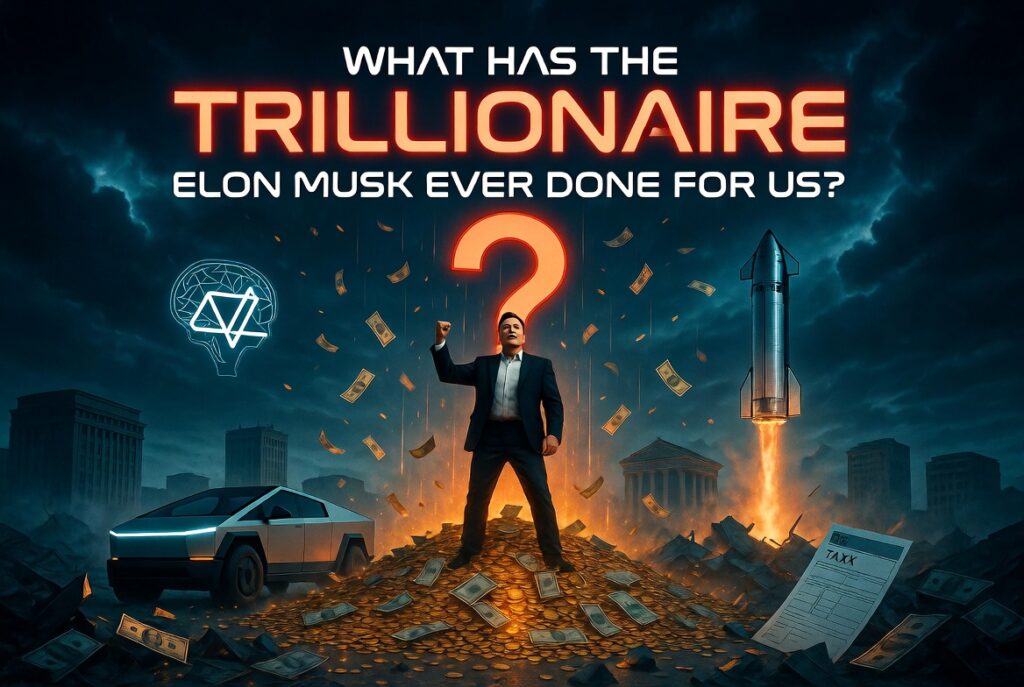
Elon Musk is now worth over a trillion dollars.
Cue the outrage.
Within hours of SpaceX’s blockbuster IPO sending Musk’s net worth into thirteen-digit territory, the political left had broken out in collective hives.
Gavin Newsom, Elizabeth Warren, and a parade of US commentators rushed to their keyboards.
Closer to home, the Green Party’s Zack Polanski retweeted a Guardian article declaring “The case for Labour to introduce a wealth tax has never been stronger.” Though, even were the case strong, it is hard to see how a US based trillionaire makes the case for a UK wealth tax any stronger.
The argument, stripped to its essentials, is one man has too much. The rest of us have too little. He needs to be taxed. And taxed aggressively.
It’s a viscerally appealing narrative.
But is it true?
And even if it were, would the proposed remedies actually work?
Let’s have a proper look.
The Guardian’s case
The Guardian piece, penned in the immediate aftermath of SpaceX’s float, makes several claims worth examining.
First, it asserts that “the world’s super-rich are running away with the lion’s share of the spoils and there is not much left for anyone else.”
This is presented as self-evident.
However, it isn’t.
Second, it cites Gabriel Zucman’s research claiming that billionaires pay an effective tax rate of only 25%, while the rest of us pay 40-50%.
It also claims that the top 200 UK families now own wealth equivalent to 22% of GDP, up from 5% in 1989.
Third, it proposes a 2% annual wealth tax on assets above $100m, with no exemptions and a “departure tax” that would treat long-term UK residents as tax resident for five to ten years after they leave.
Let’s take these in turn.
Is the UK actually becoming more unequal?
This is often assumed rather than demonstrated.
The Zucman statistics in the Guardian piece are eye-catching. It states that the top 200 families going from 5% to 22% of GDP sounds dramatic. But what does this actually mean?
First, we should note that measuring wealth against annual GDP is a somewhat unusual metric. Wealth is a stock; GDP is a flow. A family’s accumulated wealth rising relative to a single year’s economic output tells you something, but not necessarily what the headline implies.
Second, and more fundamentally, the picture of UK inequality is considerably more nuanced than the “everything is getting worse” narrative suggests.
The official data tells a different story.
The Office for National Statistics’ most recent figures show that the Gini coefficient[1] for disposable income, the standard measure of inequality, was 32.9% in the financial year ending 2024. That’s lower than it was before the pandemic (35.4% in FYE 2020) and lower than it was a decade ago (34.7% in FYE 2015).
The trend is striking. As the House of Commons Library summarises “inequality as measured by the Gini coefficient increased during the 1980s but from 1990 onwards has remained more stable.”
“More stable?” That’s not quite what the rhetoric suggests.
In fact, the ONS data shows that original income inequality—that’s income before taxes and benefits—has been decreasing at an average rate of 0.4 percentage points per year over the past decade.
The share of income going to the top 1%? It was 6.6% in FYE 2024… the lowest recorded since the series began in 2002.
The European Commission’s recent study on wealth taxation, which I reviewed in detail in a previous article[2], found that in Europe, the richest 10% held 60% of household wealth in 2023, up from 57% in 1995. The top 1% increased its share from 22.6% to 25.0%.
That’s an increase, certainly.
But it’s hardly the dramatic runaway that the rhetoric suggests.
And notably, the EC study observed that “the very top has not pulled away as dramatically as in some non-EU countries.”
None of this means inequality isn’t a legitimate policy concern. But it does mean we should be sceptical of claims that everything is getting catastrophically worse right now and therefore requires immediate and fiscally revolutionary action.
The story of UK inequality is largely a story of the 1980s. What happened under Thatcher – the structural shift away from manufacturing, the decline of unions, the Big Bang in the City – that’s when the Gini coefficient jumped.
Since then? A holding pattern. Sometimes up a bit, sometimes down a bit, but nothing like the apocalyptic spiral that dominates the political conversation.
The 2% Wealth Tax: Sounds simple… but it isn’t
Zucman’s proposal for a 2% annual wealth tax on assets above $100m, with no exemptions, has a pleasing simplicity on paper.
But as I explored in my analysis of the EC wealth tax study, the history of such taxes across Europe tells a rather different story.
The EC study examined wealth taxes in Switzerland, Spain, Austria, Germany, France, Norway, and Colombia.
The consistent finding? “Design and administration determine outcomes, and most wealth taxes have been neutered by exemptions, reliefs, preferential regimes, and weak enforcement.”
France looked progressive on paper but was weakened by exemptions for professional assets and caps that the very wealthy could exploit.
The UK Wealth Tax Commission reached similar conclusions.
Its most eye-catching models involved a one-off wealth tax rather than an annual one, and the key design point was that exceptions and exemptions should be resisted if the tax is to raise real money.
But here’s where politics drunkenly crashes into the room.
If you include pensions, main residences, and business assets, the tax base is broad and the revenue can be serious. If you exclude those assets, the tax becomes easier to sell to the public, but the tax base begins to resemble Swiss cheese.
Can anyone seriously imagine a UK government including family homes and pension pots in the wealth tax base?
The political firestorm would be incendiary.
Taxing Unrealised Gains: The Birds in the Bush
The Guardian piece doesn’t explicitly advocate for taxing unrealised capital gains, but it’s the natural extension of the wealth tax logic.
If Musk’s trillion-dollar fortune is the problem, and most of it consists of paper gains on shares he hasn’t sold, then another way to “tax the billionaires” is to tax gains that haven’t yet been realised.
I examined this in detail when analysing the Netherlands’ Box 3 proposals[3] – their attempt to move from a notional return system to taxing actual returns, including unrealised gains.
The intuitive case against taxing unrealised gains is simple: a “profit” you haven’t crystallised can disappear.
Imagine a portfolio that rises 25% in year one. Under a mark-to-market approach, you owe tax on that increase. But if markets fall in year two and the asset ends below where it started, you’ve been taxed on a mirage. Phantom profits.
The Dutch proposal tried to address this with loss carry-forwards. But that doesn’t eliminate the liquidity problem. You may have already paid tax in year one and only get relief later. Time value of money matters.
The EC study was “intellectually sympathetic” to, what they refer to as, accrual taxation but practically cautious.
No EU Member State runs a broad accrual-based system. The reasons are implementation difficulty, including frequent valuation of non-listed businesses and real estate is hard; asset prices are volatile; and paper gains create liquidity and fairness problems when no cash has been realised.
The Dutch themselves, having tried to build such a system, have reportedly “gone back to the drawing board” after criticism of its complexity and administrative burden.
Trillionaire maths and vibe politics
There’s another pattern worth noting in the Musk discourse… the numbers are often wildly wrong.
Let me present the case for the prosecution…
Exhibit A: The Green Party’s arithmetic
When Tesla approved Musk’s compensation package, they posted that it was “20 billion times more than a nurse in the UK earns.”
A quick check reveals this is off by several orders of magnitude. A UK nurse on £35,000 would earn roughly 22 million times less than $1 trillion — nowhere near 20 billion. For the claim to be true, a nurse would have to earn $50. Total. Per year.
Exhibit B: Elizabeth Warren’s 11 million years
The Senator tweeted: “The typical American household would have to work more than 11 MILLION years to make Elon Musk’s level of wealth. We need a wealth tax.”
The arithmetic is correct. Median US household income is around $80,000; a trillion divided by 80,000 is indeed about 12.5 million.
But the framing is nonsense. Musk didn’t “make” a trillion dollars through work. His wealth is overwhelmingly unrealised stock appreciation in companies he founded. Comparing accumulated asset value to annual earned income is like saying “it would take 11 million cups of tea to fill Lake Windermere” – true, irrelevant, and designed to provoke rather than inform.
Nobody “works” their way to a trillion. The comparison implies Musk somehow extracted 11 million years of wages from the economy. He didn’t. He built companies that the market now values highly. That’s categorically different from earning a salary.
Exhibit C: The non-sequitur of the week.
Erica Payne of the Patriotic Millionaires declared: “Eighty-six percent of Americans are worried about the price of food. Elon Musk is a trillionaire. These two things are deeply, inherently connected.”
This was stated with zero explanation of the causal mechanism.
How, exactly, is Musk’s paper wealth causing food prices to rise?
Food inflation is driven by energy costs, supply chains, tariffs, weather, fertiliser prices, and monetary policy.
SpaceX launching satellites doesn’t make eggs more expensive. If anything, Starlink – one of the things making Musk rich – helps farmers in remote areas access market information and precision agriculture tools.
“These two things are deeply connected” is doing a lot of rhetorical work without showing any of it.
It invites the audience to feel a connection that isn’t demonstrated. That’s not economics or grown-up politics. It’s a vibe.
Exhibit D: Oxfam’s fantasy arithmetic
The charity claimed that a 10% tax on Musk’s fortune could lift 800 million people above the extreme poverty line.
Let’s unpack that.
First, how would one actually extract 10% of his wealth. Most of it is SpaceX and Tesla stock. Selling $100 billion of shares would crash both prices… making lots of people poorer on paper.
The wealth exists on paper. It’s not sitting in a vault waiting to be redistributed.
Second, the assumption that government transfers efficiently reach the global poor is, at best… optimistic.
Decades of development economics suggest the relationship between aid spending and poverty reduction is complicated at best.
Third, it treats wealth as static. If you forced Musk to sell 10% of his companies annually, he’d ultimately lose control, the companies’ value would plummet, along with the holdings of other ‘normies’ and pension funds.
It’s a fantasy number designed to make a rhetorical point, not a serious policy proposal.
Exhibit E: “Musk pays zero taxes.”
This claim circulates endlessly.
ProPublica reported he paid nothing in federal income tax in 2018 and had a “true tax rate” of 3.27% between 2014 and 2018.
What the viral posts don’t mention is that, in 2021, Musk paid $11 billion in federal taxes. This was he largest individual tax bill in American history. He exercised stock options, realised the gains, and paid. That’s how the system works.
The “true tax rate” calculation includes unrealised gains as income – a methodological choice that no country actually uses for tax purposes, because it’s unworkable. (As we have seen, the Dutch tried. They’ve gone back to the drawing board.)
Saying Musk “pays nothing” while ignoring the largest individual tax payment ever made is not analysis. It’s motivated reasoning.
Exhibit F: Bernie Sanders’ misdirection
The Senator tweeted that “Today, Elon Musk, a trillionaire, pays the same amount into Social Security as someone making $184,500.”
This is true – the Social Security wage cap means everyone pays the same maximum.
But it’s also true of every high earner in America, and Social Security was designed as social insurance, not a wealth redistribution programme.
The cap exists because benefits are also capped.
More fundamentally, Musk’s trillion is stock, not wages. He doesn’t receive a $1 trillion salary. You can’t pay Social Security tax on unrealised capital gains. Sanders is comparing apples to rockets.
Closing statement for the Prosecution
The pattern is clear.
The numbers are either technically-correct-but-misleading (Warren, Sanders), completely unsupported (Patriotic Millionaires), mathematically illiterate (Green Party), or outright false (zero taxes).
This matters because it reveals that much of the discourse isn’t really about careful analysis of wealth, inequality, or tax policy.
It’s about expressing moral outrage.
The numbers are vibes.
Playing the man, not the ball
Perhaps I’m being naïve, but I find it hard to escape the conclusion that a significant portion of the anti-Musk frenzy is about something other than wealth inequality.
After all, the UK has other very wealthy individuals. Sir Jim Ratcliffe is worth over £25 billion. Sir James Dyson isn’t far behind. The Reuben brothers, the Hindujas, the Grosvenor estate. All fortunes measured in the tens of billions.
Where are the viral tweets about them? Where are the Guardian think-pieces demanding they pay a 2% wealth tax?
The difference, of course, is that Musk owns Twitter – sorry, X – and has used it in ways that infuriate the political left.
He’s supported Trump.
He’s amplified voices that progressive commentators would rather see silenced.
He’s become, in their eyes, a political enemy.
That’s a legitimate reason to dislike someone. It’s not a legitimate basis for tax and economic policy.
Even more thoughtful left-leaning commentators default to moral language rather than empirical argument.
Lewis Goodall—the former Newsnight political editor, now writing the ‘Goodall and Good Luck’ Substack to an audience of 29,000 put it as follows: “Musk as a trillionaire – anyone as a trillionaire – is a grotesque economic, moral and political problem.”
“Grotesque.” It’s a revealing word choice. An aesthetic judgment. A visceral reaction.
But what’s the actual harm? Goodall doesn’t say. Perhaps because the empirical case is harder to make than the emotional one.
The UK’s Gini coefficient hasn’t moved much in thirty years.
Musk’s money is mostly in companies that employ people, build things, and – as we’ll see – create wealth far beyond the founder’s bank account.
The “grotesque” framing invites us to feel rather than think.
So, basically, more vibes.
The risk nobody talks about
When Musk founded SpaceX in 2002, he wasn’t the world’s richest man.
He was a 30 year old with about $175 million from the PayPal sale and a crazy idea about going to Mars.
In summary, his friends thought he was insane.
Adeo Ressi, his college roommate and the person who’d sparked the original conversation about space travel, was “dubious” about whether a private company could even get to orbit. Others actively tried to talk him out of it.
According to Walter Isaacson’s biography, friends showed Musk compilation videos of rocket explosions to convince him not to proceed. He watched them all. Then he proceeded anyway.
“I wanted to hold out hope that humans could be a space-faring civilization and be out there among the stars,” Musk told Isaacson. “And there was no chance of that unless a new company was started to create revolutionary rockets.”
Speaking to SpaceX employees on IPO day, Musk admitted: “I gave SpaceX less than a 10% chance of succeeding at all.”
Less than 10%. And he bet his personal wealth on it.
The first three Falcon 1 launches all failed. The rocket exploded in 2006, failed to reach orbit in 2007, and blew up again in 2008 when the first and second stages collided during separation.
Musk had budgeted for three launches. After three failures, the money was almost gone.
And that wasn’t even the worst of it.
In 2008, both Tesla and SpaceX were on the verge of bankruptcy simultaneously. The financial crisis had cratered demand for cars. General Motors filed for bankruptcy. Musk faced an impossible choice: split his remaining money between the two companies, or focus on one and let the other die.
“I could either split the funds I had between the two companies or focus them on one company with certain death for the other,” Musk said. “That was a really tough decision. I decided in the end to split what I had to try to keep both companies alive, but that could’ve been a terrible decision that resulted in both companies dying.”
He added: “I never thought I’d have a nervous breakdown, but I came pretty darn close.”
Tesla’s financing round closed at 6pm on Christmas Eve 2008 – “the last hour of the last day possible,” Musk later tweeted, “or payroll would’ve bounced two days later.” He’d put in his last dollar. He didn’t even own a house.
SpaceX’s fourth launch attempt succeeded. A few months later, NASA awarded them a $1.6 billion contract that saved the company.
The rest is history. But it very nearly wasn’t.
This matters for tax policy. The UK has historically recognised that entrepreneurs who risk everything including their money, their reputation, their sanity. They deserve some recognition when they succeed.
Most don’t succeed. The failure rate for startups is brutal. The rewards for the winners are what make the game worth playing.
That’s why we had retirement relief, then taper relief. That’s why we had Entrepreneurs’ Relief, now Business Asset Disposal Relief.
The effective rate on qualifying gains was deliberately kept lower than income tax rates, because the system recognised that capital at risk is different from a salary.
The current political mood wants to flatten all of this (and the benefits are a shadow of their former selves).
Indeed, the mood seems to be to treat every pound the same, regardless of whether it came from a steady job or from betting your house on a rocket company that experts said would fail.
That’s a choice.
But it’s worth understanding what you’re choosing.
It means assuming that, without those benefits baked in, we assume that the same number of people will be prepared to take those risks or be content that there will be fewer SpaceXs.
What Has Musk Actually Done?
Let’s step back and address the question in the title of this article (assuming anyone is still with us!)
Tesla took electric vehicles from an eccentric niche product to the mainstream. Whatever you think of Musk personally, Tesla forced every major automaker in the world to take EVs seriously. From a climate perspective, that’s significant.
SpaceX has revolutionised space launch economics. The Falcon 9 is the most reliable and cost-effective launch vehicle in history. Starship, if it works at scale, could reduce launch costs by another order of magnitude. SpaceX is building the infrastructure to make humanity a multi-planetary species.
That’s… actually quite cool.
It’s worth asking that, if Dale Vince – the UK’s left-leaning green energy entrepreneur – had achieved these things, would the political left be breaking out in hives?
Or would he be celebrated as a visionary?
In my opinion, the uncomfortable answer is that the wealth isn’t really the problem. The politics is.
Musk belongs to the wrong echo-chamber (despite the landlord of the biggest echo-chamber!)
4,400 Millionaires in a Single Morning
But here’s what really got lost in the outrage cycle.
On the morning of SpaceX’s IPO, as Elizabeth Warren was tweeting about wealth taxes and Bernie Sanders was complaining about Social Security caps, something remarkable was happening to SpaceX’s employees.
4,400 of them became millionaires.
Not venture capitalists. Not executives. Employees.
As one widely-shared post put it: “These aren’t VCs. They’re SpaceX employees, and the list includes welders, technicians, and cafeteria staff, because for two decades the company paid every level of the workforce partly in stock.”
About 400 of those employees are now worth over $100 million.
The stories are extraordinary. A welder named Juan Hernandez took a $28-an-hour job in 2015 at a company he’d never heard of. He spent ten years building the structures that lifted rockets onto the launch pad. SpaceX paid him partly in stock.
On Friday, Juan Hernandez became a millionaire.
Bloomberg reported that “the SpaceX cafeteria is about to be full of millionaires.”
This is wealth creation that a government could not even dream of generating.
No public programme, no state investment fund, no industrial strategy has ever minted 4,400 millionaires and 400 centi-millionaires in a single morning. Let alone from a workforce that includes welders, technicians, and the people who serve lunch.
This happened because one man bet everything on a company that experts said would fail. And then—through a combination of genius, stubbornness, and luck—he proved them wrong. The rising tide lifted thousands of boats.
The critics want to talk about Musk’s trillion. They don’t want to talk about the 4,400. Because it complicates the narrative.
A Better Conversation
None of this means we shouldn’t have a serious conversation about wealth and taxation.
We should.
But that conversation needs to be grounded in evidence rather than outrage.
It needs to acknowledge the practical difficulties of wealth taxation, the mixed historical record of such taxes, and the genuine complexity of taxing paper gains.
It needs to look at the actual data on inequality—which shows the UK’s Gini coefficient flat-lining for thirty years—rather than assuming things are getting catastrophically worse because it feels like they should be.
It needs to reckon with the fact that entrepreneurial risk is real. Most people who bet everything on a startup lose. The few who win create jobs, technologies, and—yes—wealth that spreads far beyond the founder.
And it needs to acknowledge that much of the anti-Musk energy is about politics, not economics. The word “grotesque” gives the game away.
The EC study’s conclusion is instructive. It tells us that most countries would do better to improve their existing capital gains taxation – broader bases, fewer distortive reliefs, better anti-deferral rules – rather than assuming a brand-new wealth tax will do all the heavy lifting.
That’s less exciting than “tax the trillionaire.” But it’s more likely to actually work.
In the meantime, the next time someone tells you that Musk earning a trillion is proof that society is broken, it might be worth asking: what has the trillionaire Elon Musk ever done for us?
The answer, including 4,400 newly-minted millionaires, a revolution in electric vehicles, and a genuine shot at making humanity multi-planetary, might be more interesting than the vibe suggests.
—
[1] The Gini coefficient, also known as the Gini index or Gini ratio, is a measure of statistical dispersion intended to represent the income inequality, wealth inequality, or consumption inequality within a nation or a social group. It was developed by Italian statistician and sociologist Corrado Gin
[2] “The Wealth Tax of Nations” https://breakingtax.com/the-wealth-tax-of-nations-by-the-european-commission/
[3] (TAXING) THE BIRD IN THE HAND… AND THE TWO IN THE BUSH? https://breakingtax.com/taxing-the-bird-in-the-hand-and-the-two-in-the-bush/
Published 17 September 2026
Read More
Published 5 September 2026
Read More
Published 30 August 2026
Read More
Published 18 June 2026
Read More