
ON ILKLEY MOOR BAHT ‘AX
Read more

June 18, 2026 | 7 min read
Author: Andy Wood
Introduction
Andy Burnham thinks land is under-taxed.
The Mayor of Greater Manchester, currently vying for a Parliamentary seat in Makerfield, and frontrunner to become Britain’s next Prime Minister, has given fresh oxygen to the idea of a Land Value Tax (LVT).
This was a proposal he first championed during his unsuccessful 2010 Labour leadership bid, but an idea which has been knocking around for a long time.
With UK land valued at £7.1 trillion (according to the ONS), even a modest 0.5% levy could raise around £35 billion annually. This is roughly equivalent to abolishing stamp duty entirely.
A 1% charge could generate £71 billion.
But is this really the silver bullet Burnham suggests… or simply an old idea that keeps being dismissed with good reason?
What Burnham is proposing
Burnham has backed the campaign group Fairer Share, which calls for replacing stamp duty and council tax with a 0.48% proportional property tax.
Under that plan, an average UK home valued at £270,000 would pay £1,296 per year.
Unlike traditional property taxes, a land value tax is charged on the unimproved value of land. This ignores buildings constructed on it.
The theory is that this encourages landowners to develop unused plots or sell them to those who will.
Burnham pointed to large areas of unused land across Greater Manchester sitting idle without any meaningful charge.
He’s also described council tax as “highly regressive” and called for cuts to business rates funded through tourist levies.
The arguments for and against LVT deserve careful analysis. For a deeper dive into the theoretical foundations, historical attempts at implementation, and what the evidence shows, see my two-part series on Breaking Tax:
– PART ONE: https://breakingtax.com/land-value-tax-lvt-an-end-to-the-mother-of-monopolies-or-simply-a-new-headache-part-one/)
– PART TWO: (https://breakingtax.com/land-value-tax-lvt-an-end-to-the-mother-of-monopolies-or-simply-a-new-headache-part-two/)
The idea has a long (and troubled) pedigree
Burnham isn’t the first politician to see the appeal of taxing land.
The idea dates back to 1879 when American economist Henry George published Progress and Poverty, arguing that land’s value is created by the community – through development, infrastructure, and demand – rather than by any individual owner’s effort.
Taxing that “unearned” value, George argued, was both fair and economically efficient.
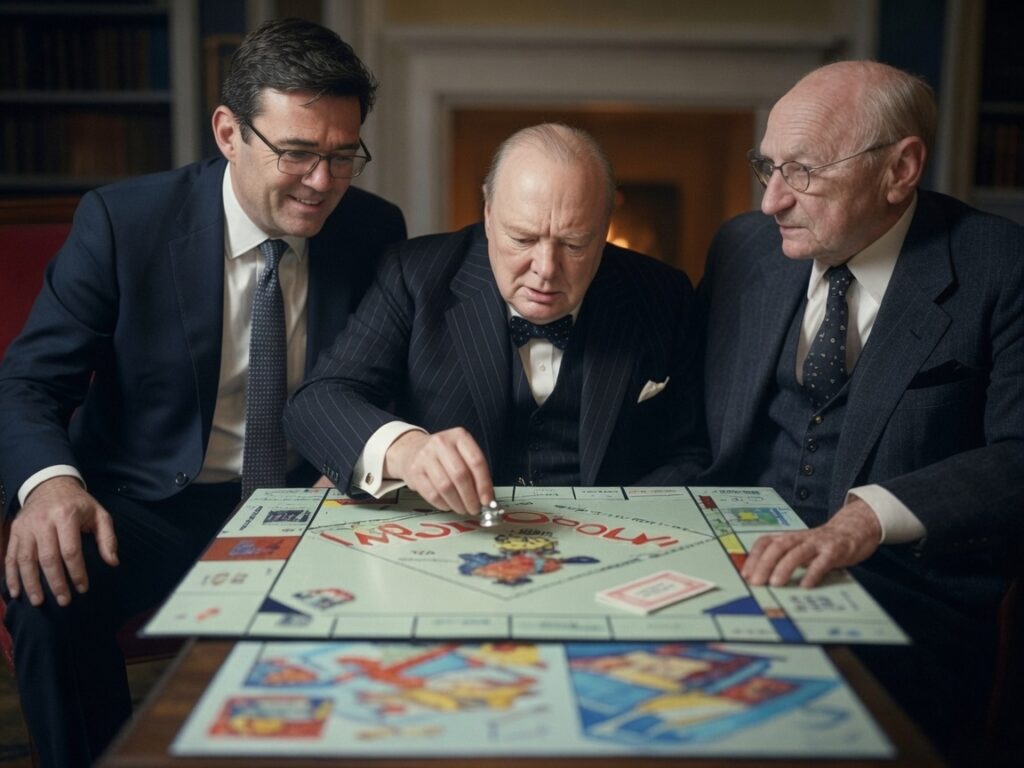
George’s “Single Tax” movement influenced reformers worldwide, including in Britain. His principles even found their way into popular culture: the board game *Monopoly* originated as The Landlord’s Game, designed by Elizabeth Magie in 1904 to illustrate how landlords profit without working while others pay the price.
Economists from Adam Smith to Milton Friedman have recognised the wisdom of taxing land. Friedman, hardly a fan of taxation, famously called it “the least bad tax,” because land cannot flee offshore, cannot be hidden by clever accounting, and taxing it doesn’t discourage productive effort.
Britain’s 1909 attempt: A cautionary tale?
The UK’s most serious attempt at land value taxation came in the People’s Budget of 1909.
Chancellor David Lloyd George, with support from a young Winston Churchill, sought to tax the “unearned increment” or the increase in land value that owners enjoyed due to development around them.
Churchill was the policy’s most eloquent champion, lambasting the “land monopolist” who “sits still and does nothing” while nearby development boosts his land value:
“Roads are made, streets are made, services are improved, electric light turns night into day, water is brought from reservoirs a hundred miles off in the mountains – and all the while the landlord sits still. He contributes nothing to the process from which his own enrichment is derived.”
Churchill called land monopoly the “mother of all monopolies.”
The political battle was fierce. The landowning aristocracy in the House of Lords vetoed the budget, triggering a constitutional crisis and two general elections.
The government eventually prevailed, passing the Parliament Act 1911 which stripped the Lords of their veto over finance bills.
But the land tax itself failed.
The required valuation took years, proved complex, yielded little revenue, and was easily avoided since it mostly applied when land changed hands. Many landowners simply held onto their land rather than trigger the tax.
By 1920, it was repealed entirely.
Britain in 1909 became a “case study in how administrative complexity can derail land value taxation.”
The transition problem
Charles Goodhart, a former Bank of England economist, has warned that if Burnham’s tax were introduced suddenly, “house prices would fall substantially.” He cautioned that doing so too quickly could “trigger a financial crisis, because many financial relationships are collateralised on property.”
This is the fundamental challenge. The arguments in favour of LVT may be “overwhelming” and its advantages “unquestionable” – Goodhart’s own words – but the transition from the current system presents “serious and severe problems.”
Homeowners who bought at today’s prices would see their equity evaporate. Banks holding mortgages as collateral would face writedowns. The political backlash would be immense.
Where it actually works
That said, LVT isn’t purely theoretical. Several jurisdictions have made it work:
Hong Kong owns virtually all land and leases it to private users. For much of its modern history, 30-50% of government revenue has come from land – allowing the city to fund infrastructure while keeping income and sales taxes low.
Singapore operates similarly, with the government owning the majority of land and selling 99-year leaseholds.
Estonia introduced a land value tax in the 1990s after independence, funding local governments and encouraging efficient land use. It demonstrates that a simple LVT can work in a modern European context.
Denmark has long taxed land separately from buildings at the municipal level,and consistently scores well on taxation efficiency
The case for… and against
The appeal is obvious:
What would it actually mean for homeowners?
Under Fairer Share’s 0.48% proposal, the average UK home (£270,000) would face an annual bill of £1,296. That’s roughly in line with current council tax for many – but the distribution would shift dramatically.
Owners of high-value land in London and the Southeast would pay substantially more.
Owners of modest properties in lower-value areas would pay less.
This is arguably fairer – but “arguably fairer” doesn’t win elections when millions of homeowners see their bills rise.
The Times analysis suggests that if Burnham went further – say, 1% – bills on valuable properties could become eye-watering, and land values would adjust downward to compensate.
Conclusion
Burnham’s land value tax proposal is intellectually serious. The support spans the political spectrum from Friedman to Stiglitz.
But Britain has been here before.
In 1909, Churchill made the moral case with unmatched eloquence. The reformers won the constitutional battle. And the tax still failed… killed by administrative complexity and landowner resistance.
Burnham’s challenge is the same one Lloyd George faced. How to implement a theoretically elegant tax in a messy world where homeowners vote, property backs mortgages, and vested interests never sleep.
If he’s serious, the path forward might look like this:
Shock therapy won’t work.
Something to think about next time you pass Go.


Published 1 October 2026
Read More
Published 23 September 2026
Read More
Published 17 September 2026
Read More
Published 5 September 2026
Read More
Published 30 August 2026
Read More