HMRC’s BLACK MIRROR MOMENT: WELCOME TO BRITAIN’S NEW BUSINESS SOCIAL CREDIT SYSTEM
Read more
May 28, 2026 | 6 min read
Author: Andy Wood
Part 3 of 6 | New Leader, Same Badger Budget
Two years ago, I described the Green Party’s tax manifesto as “mad as badgers.”
Wealth taxes. Carbon taxes at £500 per tonne. Removing the NIC upper earnings limit. Equalising capital gains with income tax. The works.
I also noted it was pretty cynical, identifying the 1-2% who would pay for everything while the rest of us reaped the benefits.
The wealthy, as Colbert’s goose, merely there to get a vigorous plucking.
Well, the Greens have a new leader now. Zack Polanski took over from Carla Denyer and Adrian Ramsay in September 2025.
The policies? Unchanged. The badgers are still very much in charge.
Let’s briefly acknowledge what’s different.
Carla Denyer and Adrian Ramsay led the party through the 2024 election, winning four seats, representing their best ever Westminster result.
But in September 2025, the party shifted to sole leadership under Zack Polanski, a London Assembly member with a background in film production.
Polanski’s pitch is what he calls “eco-populism”, linking environmental policies with socialist ones. Redistribution, workers’ rights, climate action, and taxing billionaires, all rolled into one package.
It’s not a million miles from where Denyer was, but the branding is sharper. “Cut bills, tax billionaires” is the message. Simple. Effective.
It also requires finding some billionaires willing to sit still while you tax them.
The headline policy remains a wealth tax:
Polanski claims this could raise between £15 billion and £25 billion per year.
Labour notably didn’t implement a wealth tax despite pressure from the left. Rachel Reeves has ruled it out. This leaves the Greens as the only party openly advocating for one.
Whether this is principled or merely consequence-free positioning (since they’re unlikely to implement it) is left as an exercise for the reader.
For all the wealth tax talk, the Greens remain vague on some details:
In April 2026, the Institute for Fiscal Studies released analysis warning that the Green wealth tax proposals would “backfire.”
The Treasury responded by pointing to their own Budget 2025 reforms — salary sacrifice caps, high-value council tax surcharges, as evidence they were already tackling wealth inequality without the risks of a full wealth tax.
Polanski dismissed the IFS concerns as “not credible,” arguing that claims about capital flight are overblown.
[I have talked quite a bit about Wealth Taxes in the past – most recently here].
The Greens still want to equalise CGT with income tax rates.
This would mean gains currently taxed at 18-24% would jump to 20-45% depending on total income. A significant increase.
The argument has a certain logic: why should money you earn from selling assets be taxed less than money you earn from working?
Even Churchill (Winston, rather than the cartoon insurance dog… whose tax views are unknown) made this point, though I suspect he wasn’t imagining 45% CGT.
The counterargument is that capital gains often represent long-held assets with returns already diminished by inflation, and that high CGT rates deter investment and entrepreneurship.
Labour’s compromise has been to nudge CGT up gradually, such as the increase of Business Asset Disposal Relief to 18%. Full equalisation remains a Green fever dream.
The Greens want to remove the NIC upper earnings limit.
Currently, employees pay 8% NI on earnings between £12,570 and £50,270, dropping to 2% above that. The Greens would charge the full rate all the way up.
This is a significant tax increase on higher earners — someone on £100,000 would pay an extra £4,000 or so per year.
Labour hasn’t done this. The Tories (when in power) cut NI instead. Only the Greens are swimming in this particular direction.
Another seemingly unchanged policy is to cap pension tax relief at the basic rate.
Currently, higher and additional rate taxpayers get relief at their marginal rate of 40% or 45%. The Greens would give everyone 20% relief regardless of income.
I noted in 2024 that a better policy might be a flat 30% rate for everyone being more generous to basic rate taxpayers, less generous to higher earners.
Labour has instead capped salary sacrifice contributions at £2,000 from 2029, a different approach to the same perceived unfairness.
The Green carbon tax proposal remains:
£120 per tonne initially and rising to £500 per tonne over ten years
They claim this would raise up to £80 billion.
To put £500 per tonne in context: that’s roughly £1.15 added to every litre of petrol. Your annual gas bill would approximately double. A return flight to Spain would cost an extra £100+ in carbon tax alone.
If nothing else, it would certainly change behaviour.
Whether the British public would accept it is another question. Other parties have steered well clear of carbon taxes, presumably because they enjoy winning elections.
The Greens gained council seats in the May 2026 local elections. Their message is clearly resonating with some voters, particularly younger demographics concerned about climate and inequality.
But translating local success into Westminster seats remains challenging. The Greens won four MPs in 2024, their best ever, but first-past-the-post makes further gains difficult.
Tax the billionaires plays well in Bristol Central. It’s a harder sell in swing seats where people worry more about their own bills than other people’s wealth.
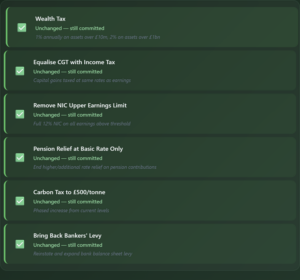
The Greens certainly get points for consistency. They believed in wealth taxes before, and they believe in them now. The new leader hasn’t trimmed the sails.
Whether this is principled conviction or opposition-party posturing is your call. The Greens are unlikely to implement any of this, which makes promising it rather easy.
What they’ve done is stake out the left flank of British tax politics. Labour won’t do a wealth tax. The Greens will.
If you want to soak the rich, you know where to go.
The badgers remain in charge.
—
Next time: Conservatives – Rebuilding from the Wreckage
Published 17 September 2026
Read More
Published 5 September 2026
Read More
Published 30 August 2026
Read More
Published 18 June 2026
Read More