HMRC’s BLACK MIRROR MOMENT: WELCOME TO BRITAIN’S NEW BUSINESS SOCIAL CREDIT SYSTEM
Read more
June 1, 2026 | 7 min read
Author: Andy Wood
UK Tax Policy Mid-Terms: #4 Conservatives
Part 4 of 6 | Rebuilding from the Wreckage
Two years ago, I reviewed the Conservative tax manifesto and called it “fiscal flotsam and jetsam” and represented the debris of a tired, sinking administration that was desperately trying to stay afloat.
They didn’t.
In fairness to the current Conservative Party under Kemi Badenoch and Shadow Chancellor Mel Stride, it would be somewhat churlish to hold them fully accountable for promises made by Rishi Sunak’s government in its death throes.
So, let’s acknowledge the context. The Conservatives are rebuilding. New leader. New shadow team. New attempt to convince the British public they can be trusted with the economy again.
However, undoubtedly, the ghost of Liz Truss still haunts the building.
For the record, here’s what the 2024 Conservative manifesto said on tax:
The thread running through all of this was: cut taxes, especially NI, and don’t touch anything that helps wealth accumulation.
Ultimately, they lost. In spectacular fashion. They don’t have to deliver any of it. And honestly, neither they nor anyone else expected them to.
Kemi Badenoch became Conservative leader in November 2024, beating Robert Jenrick in the membership vote.
Mel Stride, yes, the same Mel Stride who was Financial Secretary under May and Hunt, became Shadow Chancellor.
The immediate challenge was / is how do you rebuild credibility after the Truss mini-budget, the Sunak malaise, and a historically bad election defeat?
Answer is seemingly to establish “fiscal credibility”.
How do we know? Well, every speech from Stride mentions it. Every policy announcement emphasises it. The Conservatives are now the party of Sound Money… or at least, they’d like you to think so.
This is quite the pivot from a party that spent 14 years in government adding £1.3 trillion to the national debt.
But memories are short…
At Conservative Party Conference 2025, Badenoch dropped the headline policy of abolishing Stamp Duty Land Tax on primary residences entirely.
SDLT raises approximately £9 billion annually.
Badenoch called it “un-Conservative” a tax that punishes people for moving home, distorts the housing market, and prevents efficient allocation of property.
It has to be said that, it might be ‘un-conservative’… but it was certainly a Conservative chancellor (George Osborne) who fixated on to SDLT and other property taxes as the proverbial golden goose.
But she’s not wrong about the economics. SDLT is widely acknowledged to be one of the most distortionary taxes in the UK system. It freezes people in place, discourages downsizing, and gums up the housing market.
But £9 billion is £9 billion. How would you replace it?
Stride’s answer is through his “Golden Economic Rule”. This is that half of any fiscal savings go to reducing the deficit, half to tax cuts.
Combined with £47 billion in proposed savings (£23bn from welfare, £8bn from civil service, £7bn from overseas aid), there’s supposedly room for SDLT abolition.
Whether you believe this depends on whether you trust Conservative spending projections.
Given the last few years, trust may be in short supply.
If there’s one issue uniting the opposition parties, it’s Labour’s changes to inheritance tax on farms and businesses.
The Conservatives have been crystal clear in that they would reverse Labour’s IHT changes on family farms.
“Scrap the tax on family farms” has become a conference staple.
Mel Stride calls it “a direct attack on rural Britain.” The policy polls well in Tory heartlands where the tractor protests resonated.
This is safe political ground. It costs relatively little in the scheme of things (Treasury estimates suggest the APR/BPR changes raise £500m-£1bn annually), but it plays well with the base.
The strategic challenge Badenoch faces is that of Reform UK, and more recently Restore Britain, eating into Conservative vote share, particularly on tax-cutting credentials.
The Tory response has been to position Reform as economically irresponsible.
Stride has called Reform “economically left-wing”, a fascinating framing that essentially argues their unfunded tax cuts would ultimately harm the economy and hurt working people.
This is a credibility play. Stride effectively claiming that they’re the serious party, they’re the populists, trust us with the books.
Again, whether this works depends on voters’ memories.
Do they remember Reform’s £90bn promises, or do they remember the Conservatives’ own £30bn black hole that opened up after the Truss mini-budget?
We need to talk about the elephant, or should that be lettuce, in the room.
Liz Truss served 49 days as Prime Minister. In that time, she managed to:
Mel Stride has been explicit “We have to show we’ve learned from mistakes.” Every fiscal policy is stress-tested against the question: does this sound like something Liz Truss would do?
SDLT abolition is bold, but it’s not unfunded tax cuts for the wealthy.
The IHT farm reversal is targeted, not sweeping. The overall message is fiscal caution with selective tax cuts.
Whether this is enough to exorcise the Truss ghost remains to be seen. Labour mentions her name roughly every twelve minutes.
For all the fiscal credibility talk, there are some notable silences:
Stride’s savings plan, £47 billion from welfare, civil service, and overseas aid, is doing a lot of heavy lifting.
23 billion from welfare: This implies cuts to benefits, disability payments, or both. Reform UK has proposed similar figures. The details are thin. Universal Credit changes? PIP reforms? The Conservatives are keeping their powder dry, presumably because specifics are electorally toxic.
£8 billion from civil service: Headcount reductions, efficiency savings. Every government promises this. Few deliver.
£7 billion from overseas aid: The 0.7% GDP commitment was already reduced to 0.5% under Sunak. Further cuts would require either changing the law or creative accounting.
This isn’t a plan so much as a direction of travel. But in opposition, that might be enough.
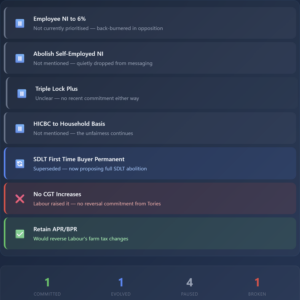
The Conservatives get an incomplete grade. Not because they’ve broken promises, but because they’re not really in a position to keep or break anything. They’re an opposition party rebuilding from historic defeat.
What we can assess is their direction:
The Truss problem isn’t solved. Until another government makes a bigger fiscal mess, she’ll be hanging around Tory necks like an albatross… or an ‘on the turn’ lettuce.
Two years into opposition, the Conservatives have stopped the bleeding and started sketching out the blueprint for an election platform.
—
Next time: Liberal Democrats – Still all a bit beige?
Published 17 September 2026
Read More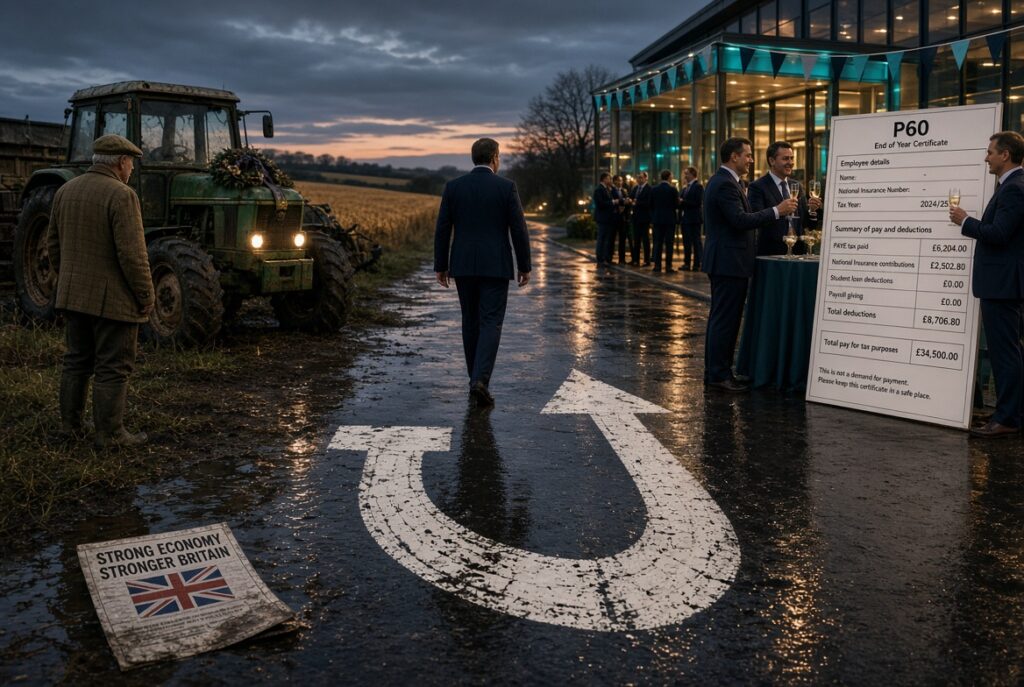
Published 5 September 2026
Read More
Published 30 August 2026
Read More
Published 18 June 2026
Read More