
ON ILKLEY MOOR BAHT ‘AX
Read more
June 5, 2026 | 4 min read
Author: Andy Wood
UK Tax Policy Mid-Terms: #5 Liberal Democrats
Part 5 of 6 | Still Beige After All These Years
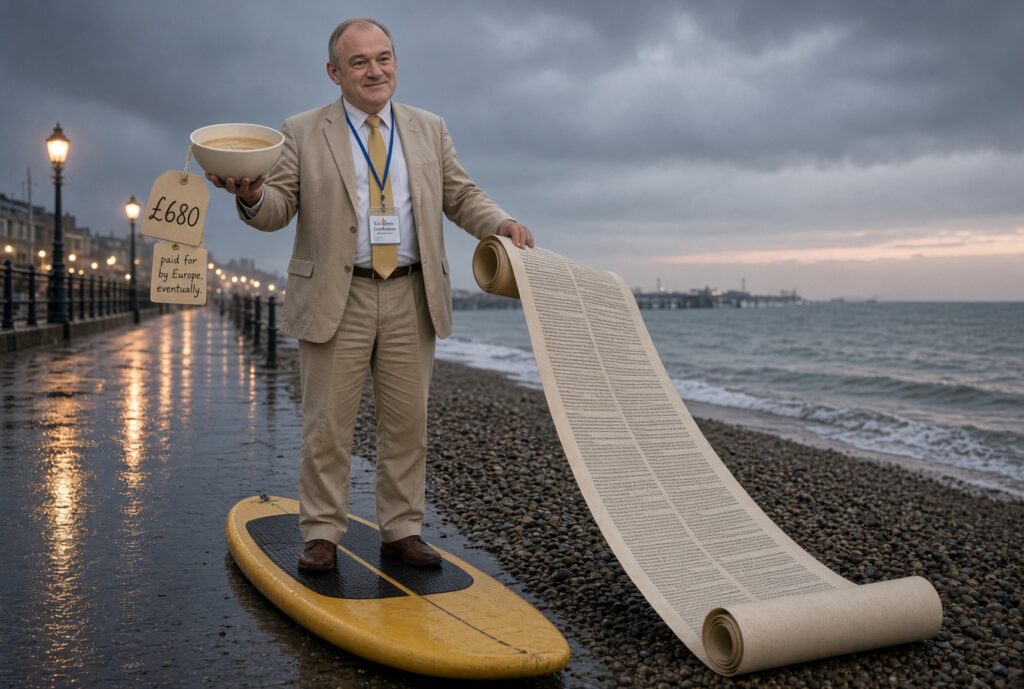
Two years ago, I described the Liberal Democrat tax manifesto as “miso soup”… warm, inoffensive, and unlikely to offend anyone.
Ed Davey was pictured paddleboarding and prat-falling.
The policies were sensible. Nobody got excited.
Two years on, Ed Davey is still leader. The policies are still sensible. I’m still not excited.
The Lib Dems occupy a peculiar space in British politics. Too centrist for the left, too liberal for the right, too sensible to be interesting.
Their tax policies reflect this.
Nothing to frighten the horses.
They gained seats in 2024, their best result in over a decade, by being Not The Tories in Tory-facing seats.
The question is whether simply being Not Someone Else is a permanent strategy.
The Lib Dem 2024 manifesto proposed:
Ed Davey remains leader. The 2025 party conference produced some policy refinements, but nothing revolutionary.
The current Lib Dem tax platform can be summarised as “taxing banks, not pubs and farmers.”
This is a swipe at Labour’s Budget 2025, which raised employers’ NI (hitting hospitality businesses) and imposed the controversial IHT changes on agricultural property.
It’s not a bad line. Pubs and farmers are sympathetic. Banks are not. If you’re going to tax someone, tax the people nobody likes.
Opposition to Labour’s salary sacrifice pension caps: The Lib Dems have been vocal critics of Labour’s plan to cap salary sacrifice pension contributions at £2,000 from 2029. Davey called it “hugely damaging to savings” and “penalising the prudent.”
This is a middle-class-friendly position. Salary sacrifice benefits higher earners most. The Lib Dems are, in essence, defending a tax perk that primarily helps their target demographic.
Opposition to IHT threshold freezes: Labour froze inheritance tax thresholds, meaning more estates are gradually pulled into IHT as asset values rise. The Lib Dems oppose this, though they haven’t committed to raising thresholds.
Continued opposition to the loan charge: This is the most consistent Lib Dem tax policy. The loan charge, HMRC’s attempt to collect tax on decades-old contractor schemes, remains a cause célèbre for the party. Labour hasn’t reformed it. The Lib Dems would.
This matters to a relatively small number of people, but those people vote Lib Dem in disproportionate numbers.
Davey has been explicit that he sees the Lib Dems as the counter to “extreme populist change” from both Reform UK and the Greens.
This is triangulation 101.
“If you’re on a low wage, Lib Dems would be your friend” is the pitch. The specifics of how remain fuzzy.
The party has leaned heavily into local community politics such as potholes, hospitals, GP surgeries. Tax policy is secondary to being seen as effective local representatives.
To an extent, this worked in 2024.
Whether it works in a general election where national policy matters more is less clear.
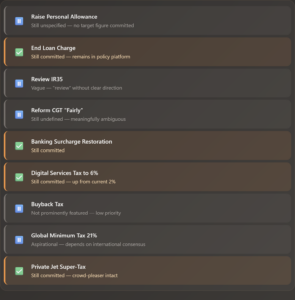
The Lib Dem manifesto proposed raising the personal allowance,but never specified by how much or how it would be funded.
Two years later, we still don’t know.
The Conservative promise to raise it to £20,000 (since abandoned) at least had the virtue of specificity. The Lib Dems remain vague.
Similarly, “reform CGT fairly” is a slogan, not a policy.
What does fairly mean? Higher rates? Lower rates? Different exemptions? All of the above?
The Digital Services Tax increase from 2% to 6% would raise meaningful revenue, perhaps £1-2 billion annually, but it’s not clear how the tech giants (and perhaps US government) would respond.
The global minimum tax push to 21% requires international coordination that the Lib Dems, as a perpetual third party, are unlikely to deliver.
The Lib Dems haven’t changed much because they didn’t need to.
They’re not in government. They’re not the official opposition. They’re the third party, winning seats by being locally effective and nationally inoffensive.
Their tax policies reflect a sensible, fair-sounding, and deliberately lacking in detail. They oppose Labour’s unpopular measures (salary sacrifice caps, IHT farm changes) without committing to their own controversial positions.
Whether this is enough to sustain the 2024 momentum, let alone achieve government, is another question.
Ed Davey remains Ed Davey.
The soup remains miso.
I feel it’s time to get out the paddleboard again.
—
Next time: Restore Britain – A new player on the outside right flank

Published 1 October 2026
Read More
Published 23 September 2026
Read More
Published 17 September 2026
Read More
Published 5 September 2026
Read More
Published 30 August 2026
Read More