CONFERENCE SEASON: LABOUR CHANGES THE CAST BUT KEEPS THE TAX BILL
Read more

June 9, 2026 | 7 min read
Author: Andy Wood
UK Tax Policy Mid-Terms: #6 Restore Britain
Part 6 of 6 | The Radical Flank
Every political movement eventually produces its own splinter faction.
The faction that thinks the original either isn’t pure enough, radical enough, committed enough to the cause.
For Reform UK, that faction is Restore Britain.
Founded by Rupert Lowe MP, the former Southampton FC chairman and briefly a Reform UK parliamentarian, Restore Britain launched as a “movement” in June 2025 and registered as a political party in February 2026.
The pitch is that Reform has lost its focus. Farage abandoned the £90 billion tax cuts. Reform now talks about “fiscal credibility” like a bunch of Treasury mandarins. Someone needs to hold the more radical line.
Enter Rupert Lowe, stage right (of course).
Rupert Lowe won Great Yarmouth for Reform UK in 2024. By June 2025, he was launching his own movement. By February 2026, it was a registered party.
The official line is that Restore Britain is a “democratic revolution” with grassroots activism to restore British sovereignty, identity, and prosperity.
The tax platform (it appears) is explicitly designed to appeal to the Reform voters who feel betrayed by Farage’s fiscal pivot.
In other words, ‘if Reform won’t promise to abolish inheritance tax anymore, Restore Britain will’.
Restore Britain’s tax platform reads like Reform’s 2024 manifesto before the civil servants got involved:
Abolish inheritance tax entirely
Not reform it. Not raise the threshold. Abolish it. Lowe calls it a “death tax that violates fundamental moral principles.”
The rationale is that you’ve paid tax on income throughout your life. The state taking 40% when you die is double taxation. Family farms and businesses shouldn’t be broken up to pay death duties. Etc.
This is emotionally compelling. And, as IHT raises approximately £7 billion annually, it is not beyond the realms of possibility.
But is this replaced / funded by taxes elsewhere, by a reduction in spending, growth or a mixture of these?
Scrap IR35 on day one
The off-payroll working rules, or IR35 to its friends (correction – it has no friends), are a perennial target for right leaning parties.
Reform promised to abolish them back in 2024.
The Conservatives promised to review them.
Restore Britain promises to scrap them immediately.
For the uninitiated, IR35 endeavours to tax those who are ‘pretending’ to be self-employed when, in substance, they are effectively an employee (if one strips away any window dressing and garnish).
However, it’s complex, unpopular with contractors, and beloved only by HMRC’s IR35 compliance teams.
It is argued that abolishing it would cost the Treasury several billion pounds annually in lost NI and income tax.
The cynic would say that contractors vote, and they donate, and (anecdotally) they’re disproportionately represented in Reform/Restore Britain circles.
However, it is clear that an awful lot of money, time and resources are spent on the ecosystem that has built up around this. It is also worth noting that the money raised through IR35 has arguably been eroded by ‘downstream’ problems it has caused. For example, in the umbrella market (those potentially in the IR35 net were corralled into brollies) such as through contractor loans schemes and other non-compliance.
It is my own view that this kind of reform would be best achieved with a merging of income tax and NIC, such that it is possible to smooth the edges of the tax system that make such distinctions (ie self employed v employed) so important.
Corporation tax: lowest in Europe
The explicit aim is Ireland-style rates, currently 12.5%, combined with tax holidays for new small businesses.
The theory is that low taxes attract business, business creates jobs, jobs generate tax revenue by encouraging the lesser-spotted economic growth. The Laffer curve in action?
Ireland’s low corporation tax required decades of EU structural funding, English-speaking workforce, and strategic positioning as a gateway to Europe.
Of course, simply arguing for economic copy pasta is not necessarily going to repeat the success of the Irish tiger.
If anyone can remember, this has echoes of Singapore-on-Thames, which I believe was a 16.5% rate, that was talked about around the time of Brexit. However, anyone attempting to exploit Brexit for the good of the economy being immediately slapped down as starting “a race to the bottom”. Instead, we must have the worst of both – in and out of the EU – worlds!
This is a reasonably radical and growth focused idea
Remittance tax
The proposal is a new tax on money sent abroad, specifically targeting remittances from workers sending wages back to their home countries.
The framing seems to explicitly discourage economic migration by taxing the outflow of capital.
Of course, this would not be without its legal and practical difficulties. But it is something quite different from anything that Reform or the Conservatives have proposed.
Restore Britain positions itself as “rewarding the nation’s grafters and protecting the nation’s vulnerable.”
This sounds nice. The policy implications are:
Restore Britain is very new. Rupert Lowe sits as an independent, having left Reform.
What it does is occupy the space Reform has vacated.
When Farage announced that £90 billion in tax cuts was “not realistic,” he created an opening. Voters who believed those promises, who wanted those tax cuts, suddenly had nowhere to go.
Restore Britain is that somewhere.
It’s worth noting how inheritance tax has become the dividing line on the British right:
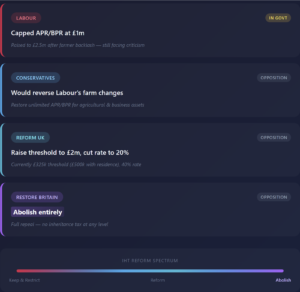
Each position is more ‘radical’ than the last.
Restore Britain has staked out perhaps the extreme on IHT – no death tax at all… ever… for anyone.
This is electorally potent, of course, in certain demographics. Older voters with assets to pass on, farmers, family business owners.
It’s instructive to compare Reform UK’s current position with Restore Britain’s:
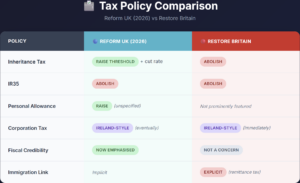
Restore Britain is, essentially, Reform’s 2024 platform without the 2025 retreat.
It’s what Reform would be if Farage hadn’t decided mainstream fiscal respectability mattered.
There’s no 2024 manifesto to compare against as Restore Britain didn’t exist.
So, we can only assess what they’re currently promising.
Restore Britain has expressed its values as lower taxes, reduced immigration, and a smaller state. The fiscal details perhaps secondary, at this stage, to the messaging.
Whether this translates into votes will, in part, depend on Reform UK’s trajectory. If Farage continues his pivot to ‘fiscal credibility’, Restore Britain may pick up some of its disaffected supporters.
If Reform crashes and burns, Restore Britain could inherit the entire base.
For now, they might be written off by many as the more radical right flank.
But so was Reform UK, once upon a time.
And so was UKIP once upon a time before that.
Published 1 October 2026
Read More
Published 23 September 2026
Read More
Published 17 September 2026
Read More
Published 5 September 2026
Read More
Published 30 August 2026
Read More
Published 18 June 2026
Read More